News & Essays

PAY THE WORKER : FUND THE WORK – pathways to a sustainable arts sector

This is the second of two essays, arising from recent revelations of expenditure by the Arts Council on a non-functioning IT system. The first and shorter one, published on Feb 24th, looks only at the immediate impact of the breaking news. This one delves into the real crisis facing the arts: the absence of a functioning system that remunerates artists in a consistent and cohesive manner for their work.

  1. REFLECTIONS ON AN OUTRAGE

A meeting was held by the National Campaign for the Arts on January 20th to canvas artists’ perspectives and views on the unfolding Arts Council crisis. There was palpable anger among delegates, at the misspending of €5.3m on a failed IT system. The anger was matched by a deep anxiety which arises not only from the fact that artists in the main are underpaid: but equally they are left in a constant state of uncertainty concerning livelihood. And this precarity causes a lingering sense of vulnerability to the spectral threat of ignorant public commentary: “What if this mishap leads to calls to reduce funding to the arts?”  Artists, the articulate, visionary, hard-working makers and shapers of our nation’s image, music and stories: celebrated at home; heralded abroad, feel disempowered in the State that trumpets their value!

Given the reports coming these weeks from the USA about the new regime’s attacks on arts organisations, and occasional noises that emanate from right wing complainers at home, this new pang of an old fear is understandable. I think, however, we can have greater faith in the Irish public and even politicians to separate the victim from the accused in this immediate situation. Even though they may not have a full comprehension of the complex and ill-suited mechanisms of funding, Irish people generally understand the value of the arts and are sufficiently intelligent to know that a thriving cultural sector must be part-financed by the modern State. The whole debacle, however, reminds us that the very means of providing for artists’ livelihoods is outmoded and unfit for purpose.

The place of the arts in Ireland is one of the nation’s comic paradoxes. The arts are generally embraced as a good news story. An Irish movie wins an Oscar: we celebrate. An Irish band wows Glastonbury, we celebrate. Artists appear on the Tommy Tiernan show and everyone applauds. The arts equally are easy fodder for ridicule the odd time a thing goes wrong. A work of public sculpture displeases a rustic County Councillor: the news goes viral. The Abbey Theatre has one of its periodic financial or governance crises, and the press goes into overdrive. And so on.

In the space of three days in February, the Irish Times gave over 12 separate articles plus an editorial to the Arts Council’s IT failings: in the same month, revelations of enormous expenditure by the Department of Social Protection on IT merited just one. Responses to arts and culture matters are inevitably disproportionate: too much excitement about the wrong things; far too little concern about the consistent failings when it comes to a modern, grown-up system of State investment.

2. AID AT ARMS LENGTH

All of this distracts even artists themselves from reflection on why the current provision systems are so unfit for purpose. Participants in the January 20th webinar were incensed at perceived Arts Council failings, and yet protective of our beloved institution. In particular, the age-old worry arose about potential threats to the ‘arms length’ principle. Artists treasure, as a matter of faith, the system that ensures that grant-aiding decisions are undertaken by an agency which is independent of political control. It is an excellent principle and one that should be guarded. The notion of local councillors or an incoming Minister for the Arts determining what art can and cannot be made or shown is anathema to the fundamental European value of freedom of expression: witness the horror show of America these very weeks as an uncultured president instals himself as Chair and chief censor of a dignified arts centre.

Solidarity with the Arts Council and it ‘arm’s length’ ring-fencing is a reassuring quality among mature artists, many of whom have been dealt crushing rejection blows by the same institution. But the centrality of the Arts Council in our thinking and our financial microsystem becomes problematic when we face the probability that a huge number of artists applying to the same Council depend on what is correctly termed grant “aid’, not only to fund their precious projects, but for their very livelihood. It is quite astounding, quarter way through the 21st century that an antiquated system of prize-giving continues to be the sole or primary source of livelihood for so many artists: more now than ever before. Imagine if nurses had to enter competitions two or three times a year; fill out absurd forms and upload letters of support, just to have wages for perhaps six to twelve weeks!

It is worth noting there are additional, complementary mechanisms whereby artists’ livelihoods are part-supported by the State. Members of National Symphony Orchestra are paid. The injection of funds from Creative Ireland into community initiatives, and improved allocations from various Local Authority arts schemes in recent years, have augmented Arts Council supports towards finite artistic work outputs, leading to improvements in livelihood opportunities for public artists, particularly in rural areas. The Creative Schools programme (est 2018) is a source of direct contract employment to approx. 130 empanelled artists nationally whose practices and qualifications include arts-in-education and inclusive participatory values.

Adding Value – Creative Ireland (Courtesy Laois County Council)

These are commendable additional initiatives, easing the livelihood stresses of differing cohorts of working artists for periods. None operate at “arm’s length” and yet they are functioning. Artists receiving fair pay or contracts (as distinct from grants and prizes) from State and local authority agencies, are generally quite comfortable responding to commissions and criteria, such as the modern school curriculum or the intelligently canvassed ideas of a community where a public artwork is to be sited. Most have independent practices outside of their commissions where other dimensions of their creative vision can find free expression. But these augmenting schemes, while showing that there are other ways to finance the arts, are piecemeal, inadequate and tend to reach only certain niches within the overall mosaic that is art making in Ireland.

3. BASIC INCOME

In 2022, a new and radical idea was piloted, which for the first time in history seeks to separate the matter of livelihood from that of specific projects and artworks. The innovative concept goes under the official title, Basic Income for the Arts. The title is slightly problematic, as discussed below: but in 2022, it represented innovative thinking, although not an entirely new idea.

Some moves to secure artists’ livelihoods have been made historically, but the scale and nature of the initiatives have always been too little, too late, or too fraught. Aosdána was established in 1981, out of a genuine concern that a coterie of established and respected artists of the era faced penury. It has come under scrutiny from time to time and while it certainly has alleviated poverty stress for a minority of artists – and sought to do so in a dignified way with the veneer of a noble function – it has been described by many as an anachronism in the modern age.

The BIA pilot scheme is not dissimilar to Aosdána in the practical sense that it guarantees income to certain artists, in a way that respects the unique nature of artists’ work and productivity, but without the public elevation and odd pomp and ceremony of the old institution. Entry to the BIA scheme is more egalitarian and discreet than is the case with Aosdána. Recruitment to the pilot was based upon a lottery among thousands of artists deemed eligible, rather than arbitrary barometers of grandeur.

The BIA trials, however, have scarcely scratched the surface numerically, and the future of the scheme is anybody’s guess. Its primary champion, former Arts Minister Catherine Martin, is no longer in office. The pilot phase saw benefit for 2000 artists (out of 14000 deemed eligible). It runs out this year. Expanding the scheme is a key demand of the National Campaign for the Arts. Given that the new minister has distinguished himself so far only in his outraged reaction to the Arts Council IT mess, which he regrettably inherited, and his plan to expand his “waste removal” crusade to other cultural bodies, it is difficult just yet to see him in the role of magical dispenser of a radical and costly payment scheme, however necessary, directed towards the bank accounts of artists.

On the plus side, re-elected cabinet members are bound – up to a point – to accept the evaluation reports on the pilot they signed off on, and take some action. The new  Programme  for Government includes a commitment to  ‘assess the Basic Income for Artists [BIA] pilot to maximise its impact’. It would be politically regressive to abandon the programme completely; expedient to repeat or expand it in a niggardly way.  If we are optimistic, and the number is – say –  doubled, it will ease distress for a few thousand more artists. However, it will still leave thousands of hapless applicants to its lottery selection not so much disappointed, as terrified and despairing when the letter of rejection arrives.

All parties need to take a helicopter or space satellite view. If we value the Arts as we value Justice, Education, Environment and other non-tangible public benefits, then we as a society (including artists) need to rethink what an artist in 21st Century Europe looks like, and how modern artists should be paid and protected. What is certain, is that the Arts Council is not equipped for the absurd task it now de facto faces.  No artist, recognised as an artist, in a European nation should go hungry while waiting on annual or bi-annual bursary and project award schemes, in the hope, if they are truly excellent, that they might get lucky once every three or four years. Right now, we are working with twentieth century, cobbled-together solutions, and hidebound by nineteenth century perceptions and definitions of the artist as so utterly ‘other’ that simple systems of recognising work as work cannot apply.

Cobbled together – actor Brendan Laird at work

HOW ABOUT “BASIC WAGE” FOR ARTISTS?

This is where the concept of Basic Income may need re-naming and some re-design.  The current title is borrowed from the Utopian and humane “Universal Basic Income” idea which negates conventional industrial notions of productivity in an ideal world, and provides unconditional payments to all citizens. In the harsh politics of this century, there needs perhaps to be a more forthright assertion, not of the right of artists in some exceptional way to a unique, unconditional stipend, but of the hard fact that artists work and are grossly underpaid for their work!

Most professional artists work all the time. They live in society, and their work – even the wildest and most esoteric – benefits society. The ways of benefit are so many that listing them inevitably drags the conversation into reductive and outmoded mutterings about instrumentalism: yada-yada tourism spinoff, mental health of the nation, creative learning, taxes paid on earnings, spectacle, festivity, family fun, fodder for necessary outrage, and of course Art for Art’s sake – yada yada, I could fill another page. It is all noise! Either we value the arts for their intrinsic value – regardless of how this kind of art or that kind of art impacts in this parish or that neighbourhood, yonder gallery or some fringe theatre or burlesque somewhere: or we do not!  And if we do, then it follows that we pay our artists to get up in the morning and continue to work, as they do, day-in-day-out.

It pleases me to say that in Ireland, notwithstanding the occasional daft view, we do value the arts! It is imperative therefore that we provide intelligently for the livelihood of working artists, just as we provide for our guards, teachers, state foresters, tax collectors, nurses and lifeguards. They get a thing called a wage. Why did we fail so completely for so long, to think of this? Possibly because the true cost was always going to be considerable, although ultimately still but a drop in the overall public spending ocean. Equally likely, it is because, although the solution is so obvious and right in front of us, we have been unable to see it for the silly noise and flashing screens of media chatter that continually distract us. And when a move was finally made in 2022, to pilot a livelihood scheme that separated the holding of a skilled profession from the act of showcasing, it was clumsily named to fuel further the sniggering myth that artists don’t really work at all. Call it a wage and let it be a transparent and accountable transaction!

One thing is for certain, the task of providing essential income to artists cannot be delegated by default any longer to The Arts Council. The institution is unfit for such a purpose, not because its IT machinery is not up to the job, not because its overworked staff are anything less than dedicated, and not because the principle of financing fabulous projects by fine companies and artists is not commendable, but because the ask facing the Council in the absence of a parallel income scheme is impossible. For every 5% increase in Arts Council funding, comes a 10% increase in demand, as more and more young people and new Irish residents, trained and qualified as artists, come forward, aware in the information age of the competitive schemes that exist. We rely far too heavily on our beloved ‘arms-length’ awards agency not only to fund our ideas, but to provide many of us with our only hope of a wage, doing the only thing many of know how to do, and which so many of us do, so very, very well, to the benefit of so many around us.

The Two Five Ones: Culture Night Co. Monaghan 2018

In summary, we need a system of secure and long term waging for artists. Continue to call it Basic Income if you must. Or perhaps create an opt-in, transparent and accountable National Artists Panel, where those registered are openly and proudly identified, entrusted and waged so as to be enabled to make their art in the million different ways of artists, with all of the intangible but visible impact of art, however diverse, however sporadic, however socially engaged, however bafflingly impenetrable, without dependence on the whims of markets or competitive award races. Provide a livelihood to artists to work as they do, over full years of sometimes frenetic, sometimes quieter periods, just as we provide livelihoods to our soldiers in peacetime as well as in conflict; our park attendants in winter as well as in spring; our librarians even on the days when only one or two people come in the door.

And then, like the public engineer who is paid a wage and – separately – provided with a budget to build a bridge or canal, our waged (not “aided”) artists can tender for the additional finance and resources to build their imaginative bridges and roads and fabulous flying machines.

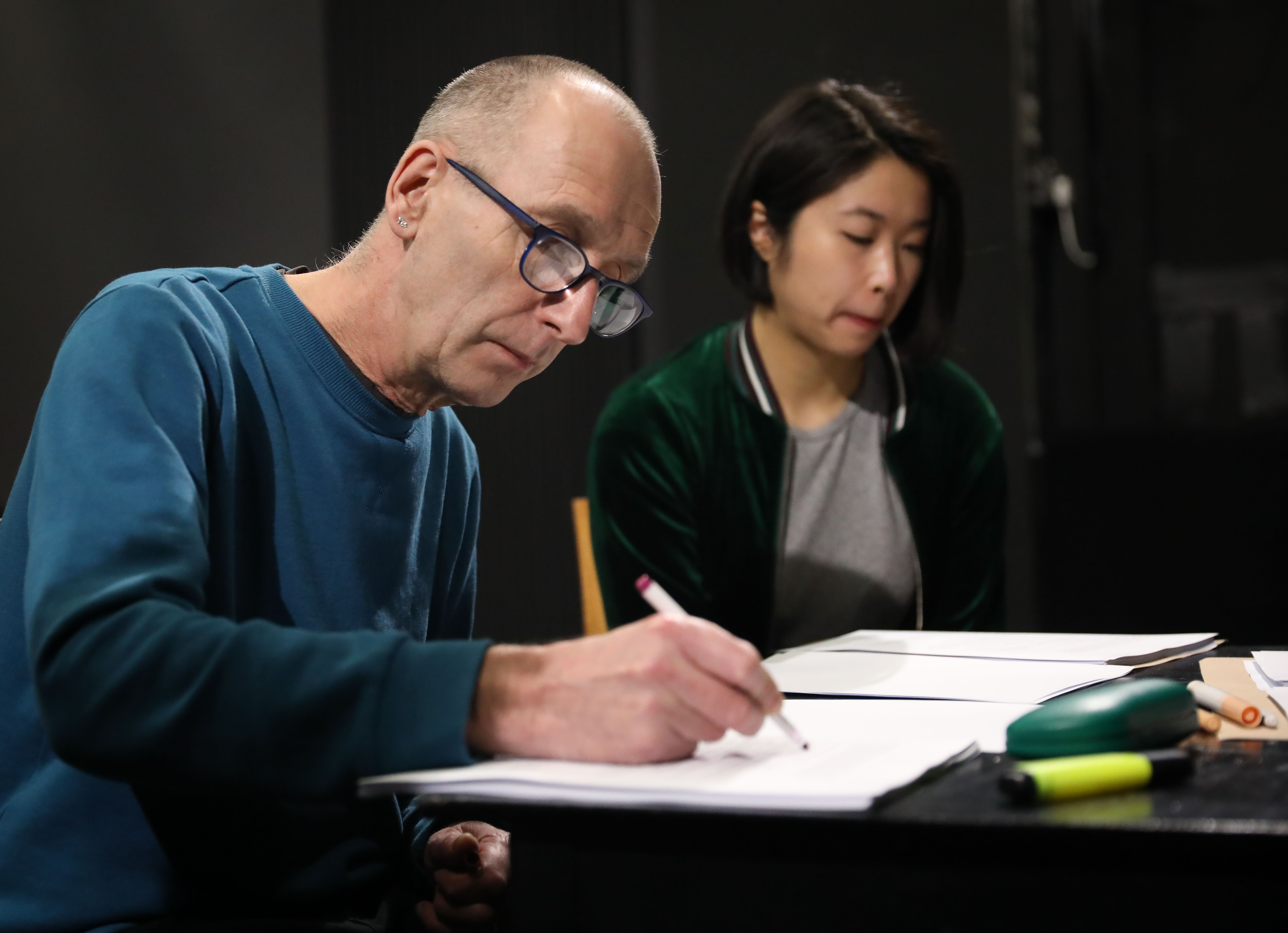
Constantly working! The author along with lighting specialist Veronica Foo

And of course, people will ask: Ah, but what about abuse? Simple: treat it the same as abuse in any other field! I have almost never met a lazy artist. If a handful of messers exist, referring to themselves as artists but never working as artists, they can be quickly exposed as con artists. There will be ways to identify and exclude fraudsters from ill-deserved earnings, just as we root out corrupt police officers, expose millionaires wrongly awarded telecoms contracts, and (if only we would) vote out unfit politicians. But having worked as an artist among artists and nothing else for 40 years, and having sat on some of those benighted local authority and Arts Council peer panels that assess funding applications from young and mature artists, desperate to just work and be paid, I would wager that slackers in my sector are very, very few. The real abuse is the false sense we give to our young theatre graduates and stressed-out mid-life artists that just because they work hard and bring us joy and stimulation, they can live and make a career.

So my simple plea to the new minister, once he has fully sounded his bark and completed his sniffing around for suspected waste: Rearrange things! Demand all-of-Government engagement: create a viable public art register and system whereby we pay a wage, not to two thousand but several thousand of our artists.

And once the immediate governance questions are resolved, leave the Arts Council, without interference – and with adequate funds and IT systems – to look after quality assurance; funding of sustainable organisations; and yes – continuing with their prize-giving competition schemes that recognise particular individual excellence. In this way, Arts Council money is used intelligently to underwrite the researches and the outputs, but not the mortgage payments, the nappies, the dinners and the human right to a regular wage, of our nation’s artists.

THE COST OF IT: reflections on a public spending crisis

The news that the Arts Council has lost €5.3m (confirmed figure) on an IT system that was unfit for purpose has caused understandable concern among the general public and anxiety within the arts sector. This is a serious matter which requires investigation and accountability, but also perspective and measured responses, particularly from artists through their representative associations.

The widely reported debacle has left artists worried that the cost of fixing the situation may be met by reductions in the Arts Council’s overall allocation from Government, leading to reduced grant levels for an already cash-strapped sector: in short a worry that artists will ultimately pay for errors not of their making. This is hardly surprising. Few sectors were more unfairly punished in the 2008-2013 period for the catastrophic errors and corruption of the then government, the banks and builders, than the arts. This is a rather different situation, however.

The Arts Council has given strong reassurances to the National Campaign for the Arts that whatever the outcome of the current investigations, grant supports will not be affected. Some may ask if it is within their gift to make such assurances since their Government paymasters might punish the agency to a degree that will leave the Council’s hands tied. But it bespeaks a reassuring determination, and one which should remind artists that for all its inherent flaws, moments of human error and its own impossible financial situation, the Arts Council was always and remains committed to support for the arts and the rights in principle of artists to fair livelihoods.

Since the precise nature of the failings are now a matter of formal investigation, it is unhelpful prematurely to leap to judgement or apportion blame here. The new Arts Minister and the Minister for Public Expenditure were quick to suggest that the Arts Council’s actions “likely” breached public procurement rules. Time and independent audits will tell.

What is clear is that the moneys being paid out by State bodies generally to private sector IT companies is exorbitant. In the same week that the Arts Council story broke, a parliamentary question brought to light the fact that the Department of Social Protection in the same period was paying €5.6 million PER MONTH to IT contractors! One Netherlands-based company alone is reported to have been paid a total of €48m of Irish taxpayer’s money over two years. This company reported a pre-tax profit of €8m in 2023. At least those costly Social Protection systems appear to be functioning. But this disclsure of the scale and cost of State dependence on the commercial IT sector helps put the level of the Arts Council’s wasted expenditure into some kind of perspective.

While our gaze is naturally turned on the public servants within the Arts Council and the Department of Arts and Culture who watched this money slip between their fingers, nobody seems to have asked how such highly paid IT wizards managed to misread so badly the needs of a relatively small Irish state agency and take them for such a ride over four years, failing, by all accounts time and again, to provide the service they promised to deliver. Will the enquiry include an option to blacklist such companies from future tendering, should incompetence or deliberate spinning out be uncovered?

As to how the Arts Council loss impacts upon artists, the very mention of a €5.3m loss causes natural anger and trauma. That kind of money could have funded an awful lot of arts projects. It rings dreadful in an underfunded sector. But as against that, these moneys were never intended for artists supports; rather to improve systems of assessing grant applications, as well as other internal corporate needs.  And as the DSP statistics (and the ongoing Children’s Hospital overspend of 1.5 billion euro) reminds us, the sum involved is not ultimately a catastrophic loss to the State coffers. It should not have happened, it must be rectified and persons help accountable, but correcting it will not send the economy into a tailspin in the way that the bank guarantees and bailouts of fifteen years ago did.

Let the matter, therefore, be cleared up and let us hope that the crisis might cause renewed examination of the real problem alluded to above: the precarious position of artists and arts workers in Ireland.

WATCH HERE FOR A SECOND ESSAY LATER THIS WEEK, LOOKING AT CAUSES AND SOLUTIONS TO “THE REAL PROBLEM: THE PRECARIOUS POSITION OF ARTISTS AND ARTS WORKERS IN IRELAND

FUNDING RECEIVED FOR A PERSONAL PRISM

A Personal Prism

I am pleased to announce that playwright David Joyce and I will be working together to bring Dave’s beautiful play “A PERSONAL PRISM” to the Black Box Theatre Galway, and thence on a mini-tour to Portumna and Tuam this November.

Dave and I wish to acknowledge the support of The Arts Council / An Chomhairle Ealaíon. We were pleased to win a Theatre Projects Award 2024 to bring “A PERSONAL PRISM” to the stage and undertake an integrated programme of regional workshops and conversations over coming months.

The play introduces Lee Hanley a young man with a disability living in a small regional town, who struggles with anxiety, family pressures and the myriad of additional challenges faced every day by wheelchair users, all the while pursuing a dream. It raises themes of creativity, community, isolation and friendship in a humorous and yet searingly honest story.

In April, shortly after winning our award, Dave and I went on a whirlwind trip around Co. Galway to meet some of the key partners who have worked with us over months and years to get to this point. (See photos).  This project would never have happened without the support of these local arts partners: Town Hall Theatre Galway; Portumna Town Hall and Creative Places Tuam; and our local disability partners The Galway Centre for Independent Living and Irish Wheelchair Association, Galway.

Additional national and regional partners with whom we shall work over the summer are: Arts & Disability IrelandDisability Federation of IrelandSpinal Injuries Ireland and County Roscommon Disability Support Group.

We owe special thanks to Pamela Mc Queen whose previous input as dramaturg was invaluable: also to actors Eoin Ó Dubhghailll, Joe MacCarrick and Cáit An Fhile who took part in developmental workshops in 2022.

FULL DATES AND BOOKING DETAILS WILL BE PUBLISHED HERE IN DUE COURSE

IMAGES:

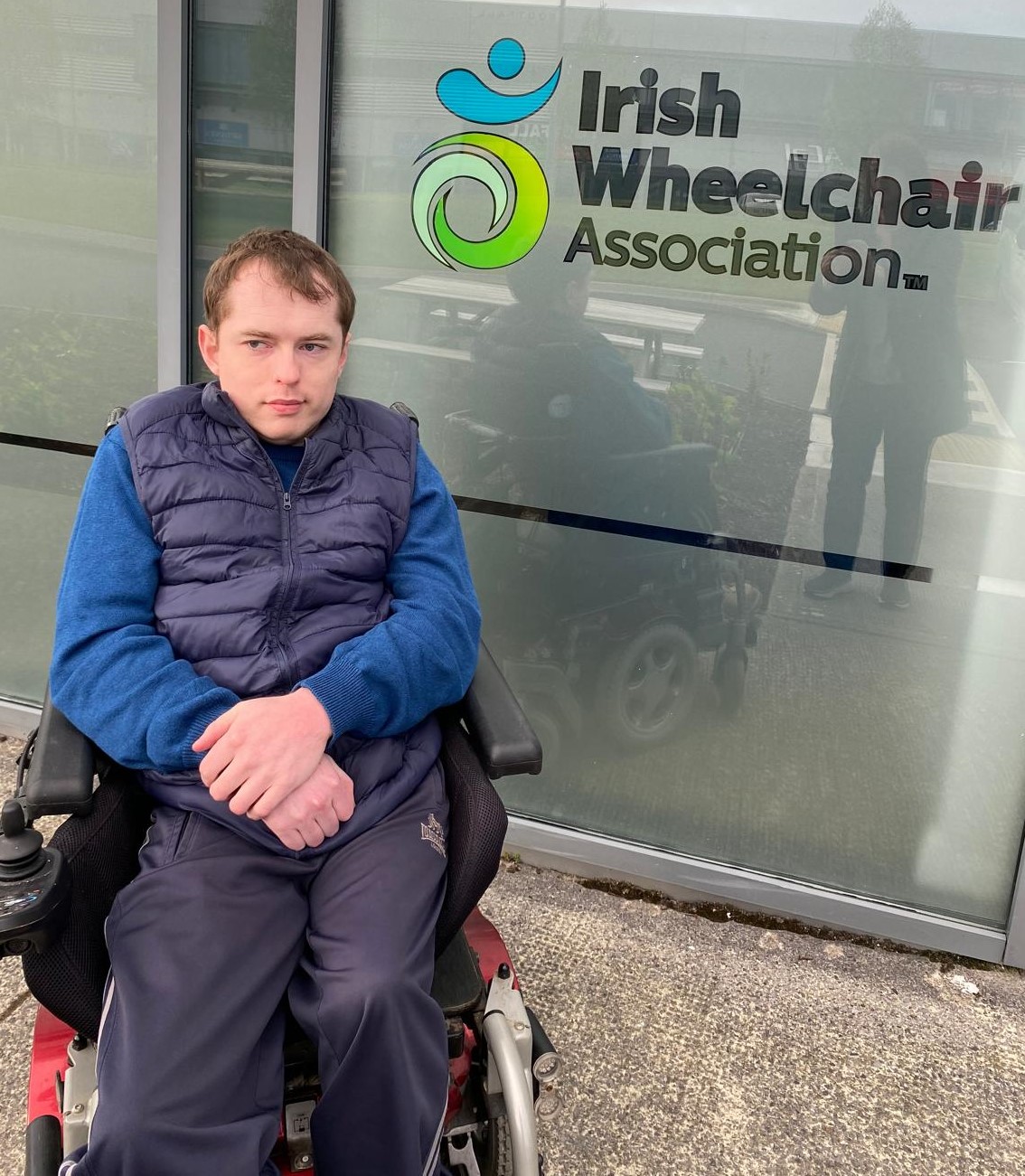
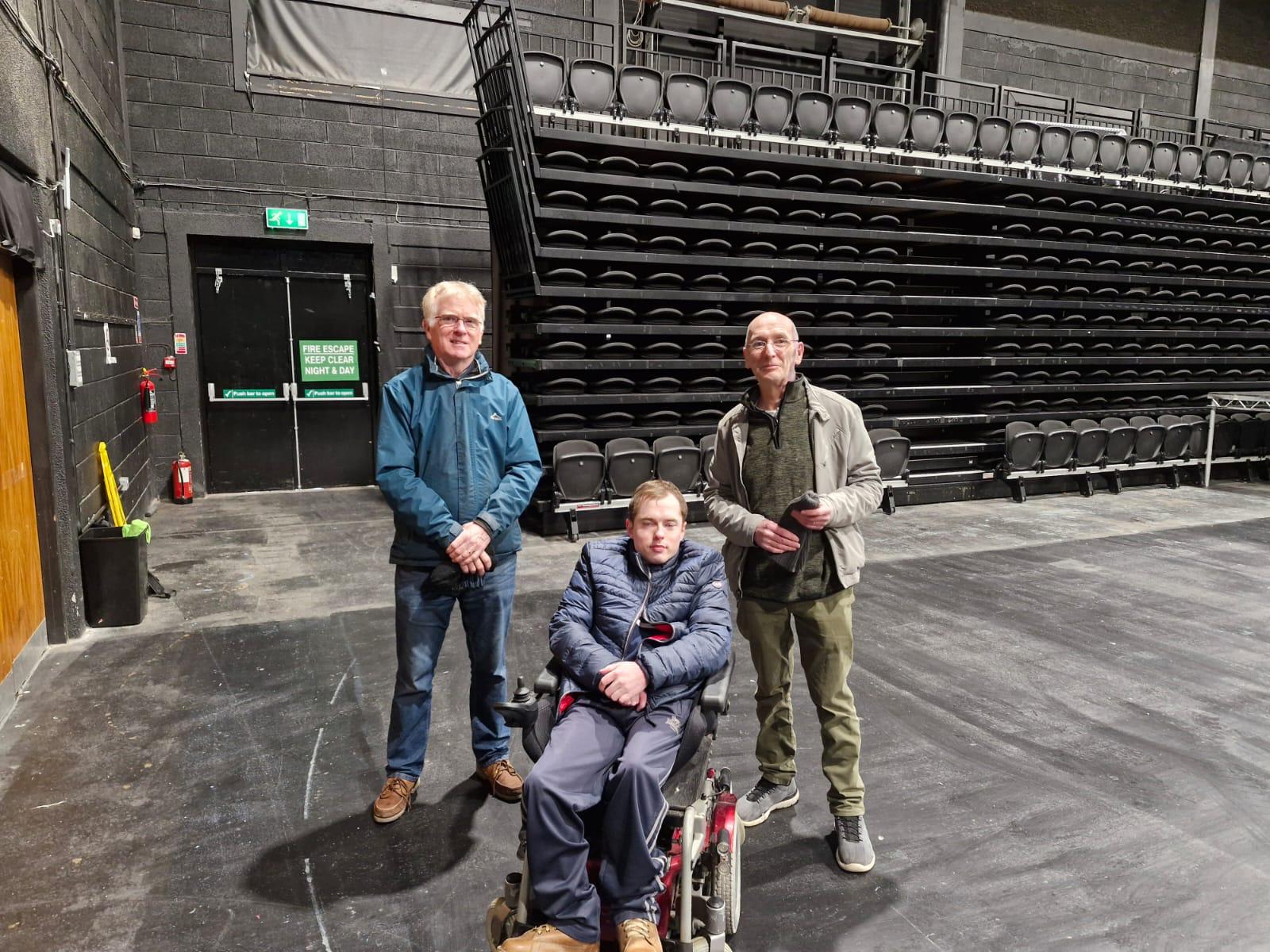
Above: Dave and I received a warm welcome from Phil and the staff at Galway Centre for Independent Living: Top row below: Dave at IWA Galway; with Fergal McGrath at Black Box Theatre; with Jim Hynes at Portumna Town Hall: Bottom row below: Planning meeting with Carolann Courtney of Creative Places Tuam.


ON TOUR IN ONTARIO

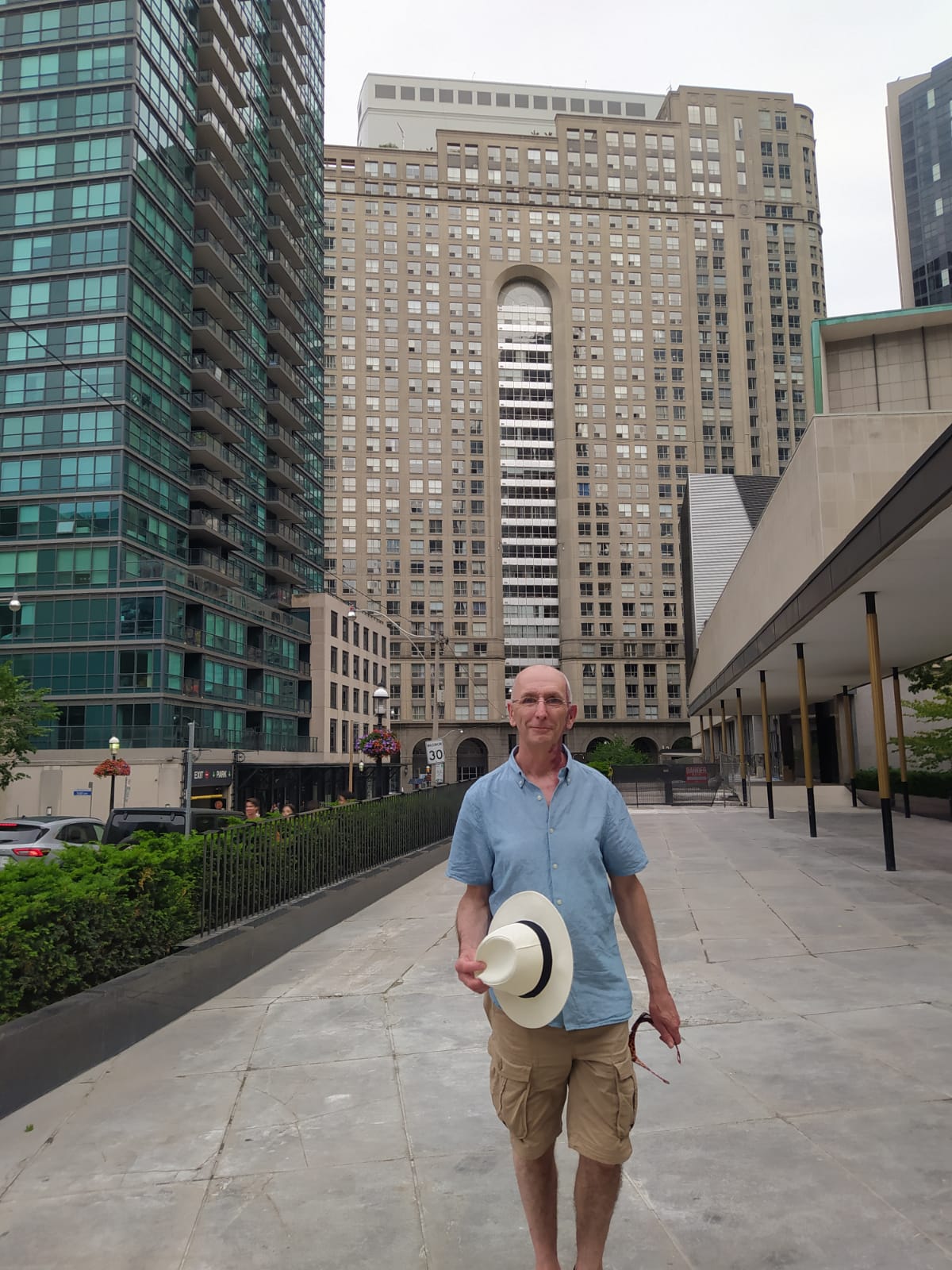
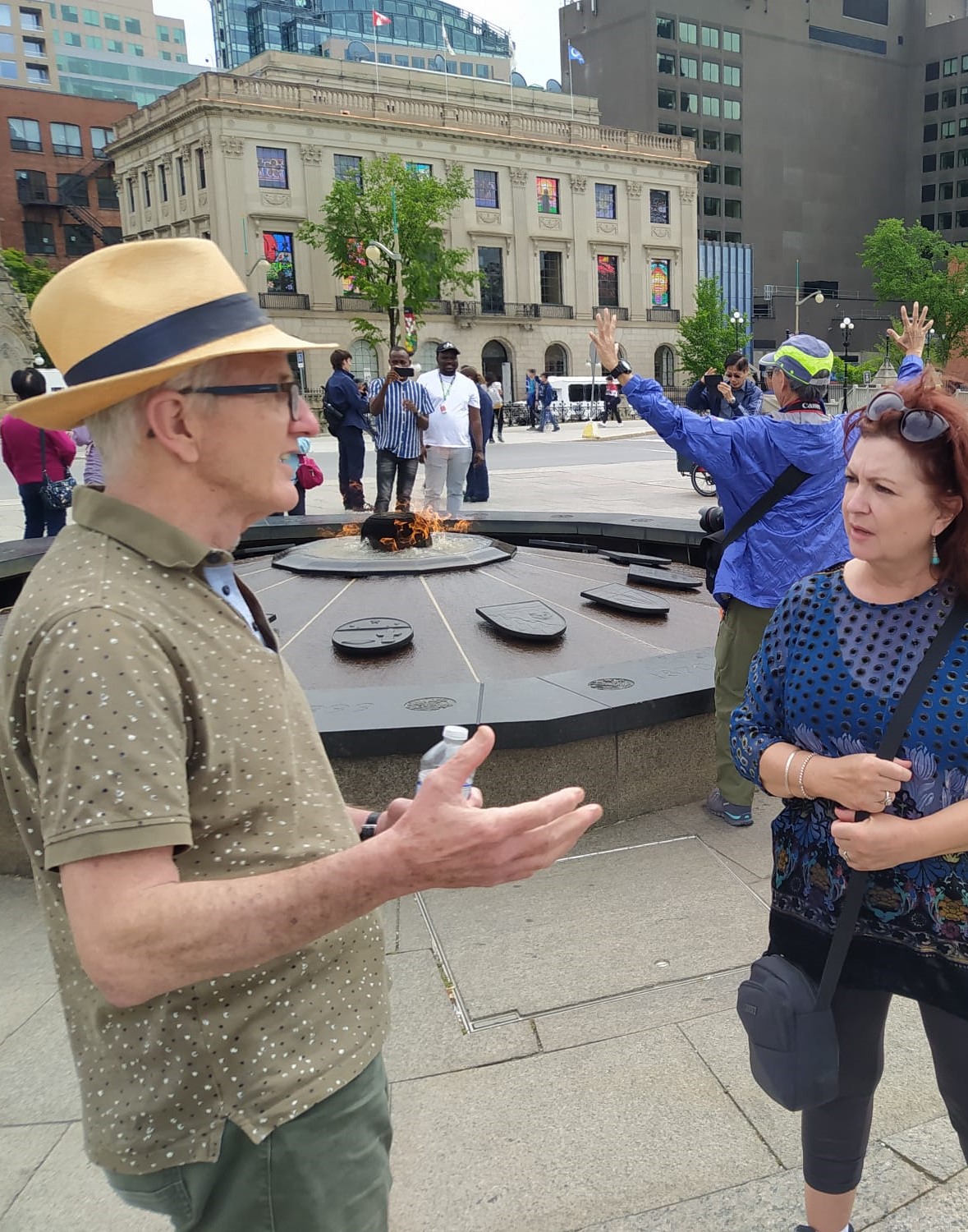
Capital City! Relaxing before the first performance of the Canada tour.

A highlight of 2024 so far has surely been my 9-day June trip to Ottawa, Toronto and Hamilton, Ontario, to perform from the works of James Joyce as part of the Global Bloomsday 2024 festival.

Why Canada? Well, a couple of reasons. In conversation over Christmas 2023 with my old friend, noted Joycean and authority on modern Irish history Des Gunning, it came up that a number of significant commemorations would arise in 2024. The 85th anniversary of the establishment of diplomatic relations between Ireland and Canada would coincide with the 85th anniversary of the publication of James Joyce’s “Finnegans Wake” and indeed the 100th anniversary of the first controversial appearance in print of a segment of that famously difficult book, in a transatlantic literary journal.

To a sociable Joycean historian, and a travel-hungry troubadour, that led to the obvious conclusion that what Canada needs now is a celebration of James Joyce, ideally one involving me! Canada is not without a significant tradition of honouring James Joyce already. Montreal, Toronto and Ottawa have active Joycean groups and a tradition of Bloomsday celebrations involving some truly gifted actors and scholars. Toronto is home to One Little Goat theatre company which is toing and froing across the Atlantic these very weeks, gradually creating a podcast performance of the entirety of “Finnegans Wake” to be ready in time for its 90th anniversary in 2029. But, I reasoned, Canada has not yet had me.

The difficulty that morning of dreams appeared to be that my work with Joyce has tended to draw from the earlier, more accessible books, “Dubliners” in particular, while the occasion seemed to call for a remembrance of “Finnegans Wake”. In fact, it called specifically for a revisiting of “Mamalujo”, the episode of the book which was brought into the world by Ford Madox Ford in 1924. Or at least so it seemed to Des. And so was born the idea that I might create a performance around that seminal episode.

Conspiring with Des Gunning

Perhaps if I had actually read it first, I might have baulked.  I certainly entertained second thoughts in the intervening months as I worked frantically to try to engage with the 688-page monkey puzzle that has divided opinion ever since that short excerpt first popped up innocuously under the title “Work in Progress” in The Transatlantic Review.

I did articulate to Des that if I was going to put my head in the guillotine and attempt FW, I should also be allowed to revive my old reliable (and favourite) Joyce performance, “The Dubliners Dilemma”. I also quickly determined that I could not, in all honesty, create nor sustain a full, off-book solo performance based on the Wake nor any part of it in six months, given that scholars have given over their entire adult lives to its many layers of meaning. And so it was settled that I would look at “Mamalujo 1924” as the transitional moment between Joyce’s early work and his final great book which is written in a ‘new world language’ that took him 15 years to complete and takes many people 15 years to read. I would pose the question, how did Baby Tuckoo, Joyce’s alter-ego in the cradle, fascinated by words and songs, progress from a love of sounds to the invention of a language.

Oh yes, and it would be kept short enough to fit into a double bill with a rumbunctious revival of “The Dubliners Dilemma”. I would be like an old rocker who performs the new album but keeps the fans happy with a few of the old classics. And there we had it, all planned over coffee and muffins in a café at Ashtown Gates in January, with just two glitches. Nobody in Canada knew about it. And we had no money.

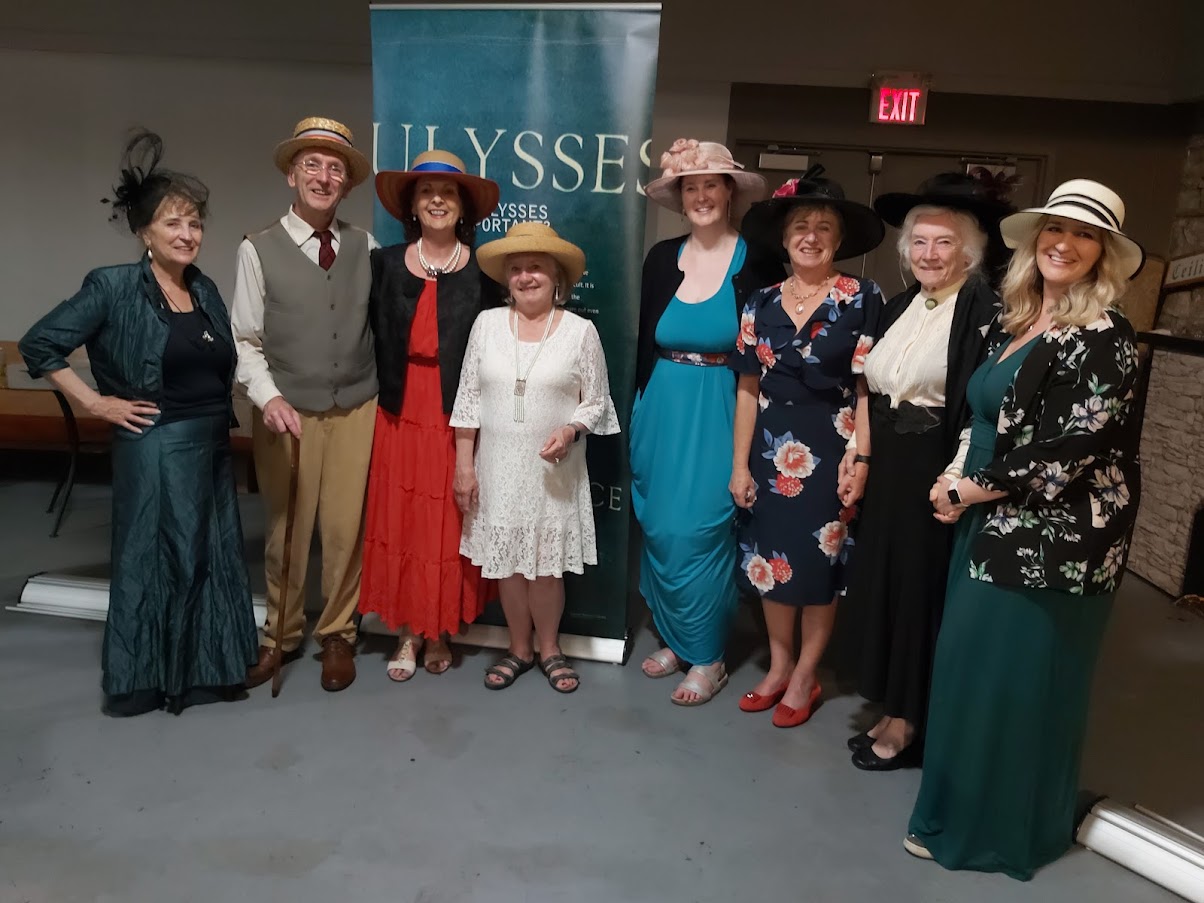
The James Joyce Association of Ottawa Committee: June 13th 2024.

We managed within days to elicit an invitation from the notable James Joyce Association of Ottawa who had bravely undertaken to mount a few events in 2024 specifically to highlight “Finnegans Wake” in its anniversary year. And I now submitted what seemed like a shoo-in proposal to Culture Ireland with a not-unreasonable request that the Government of Ireland might provide the modest sum of money it would take to cover my flight and my accommodation in Ottawa.

Being a master of the ulterior motive, I had another reason for wanting to visit Ontario. Members of my father’s family had emigrated there from Donegal in the last century, and I have living relations in Ontario that I had never visited on their own turf. I have a fascination with migration and it has featured as a theme in my work. Also, the older I get, the more I regret not keeping in closer touch with wider family: I have grown to understand the importance of heritage. So, privately, I thought I might pop down to Toronto to visit the folks! 

I began the stern task of writing what became a not-too-stern spoken word piece about James Joyce, his wonderful book “Finnegans Wake” and how it is anticipated in his earlier works, and all was good in my world.

Until Culture Ireland, overwhelmed this year with applications, declined to fund the trip. I was dismayed but sanguine: tendering is a gamble: you win a few, you lose a few: they have generously funded some of my earlier work.  But the deliberations had been delayed. By now it was April of the year and I was knee deep in a plan for June that could not be realised.

Until…. the good people of Canada, my own remarkable cousins among them, rallied around. Even without State imprimatur, the James Joyce Association of Ottawa announced it would honour its commitment to a fair professional fee if I could find my way to their fair city by other means. My cousins Ann Gorman McKinney and Seanie Gorman committed to finding viable gigs for me in the Toronto region to help defray the costs.  And so it all took flight again – on a wing and a poem.

“Welcome O Joyce” Work-in-Progress: James Joyce Centre, Dublin

I previewed “Welcome O Joyce” co-conceived with Des Gunning, at our partner venue The James Joyce Centre in Dublin, in early June. It suffered the kind of teething problems that uncertain new works often have. I went home that evening marginally chastened by the realisation before a live audience that our new chicken had come out of the egg a little wobbly. But I listened to the constructive feedback of scholarly friends, pruned ten minutes off the running time and – in correspondence with a by-now very busy pre-Bloomsday Des – recalibrated the performance somewhat for Ottawa.

With Gerard Lee in rehearsals (screengrab – Bloomsday FB reel)

I had already indicated that in Toronto and nearby Hamilton I would only perform “The Dubliners Dilemma”. But even that old familiar work involved much preparatory work, and I was grateful as ever to have trusted director Gerard Lee back in the rehearsal room with me as we reassembled our much-travelled show, after a gap of five years and a pandemic. Memory is a curious friend – it did not come easily but when it came, it felt like an old forgotten hat that sits on the crown comfortably again after years in the attic.

Sharon Cromwell my life partner and great pal travelled with me.  At 9.00 Irish time on Tuesday 11th June we left our cottage home at Loughshinny on a 33A bus to Dublin Airport. We transferred from Toronto Pearson to the Via Express at the magnificent Union Station and travelled onwards to Ottawa by rail, arriving at our destination nineteen hours after we left home. We were warmly greeted on the platform by Dublin friend and Ottawa committee member Paula McCann, and her wise and wonderful husband Don Cummer, who whisked us to our hotel in the evocative Byward Market area.

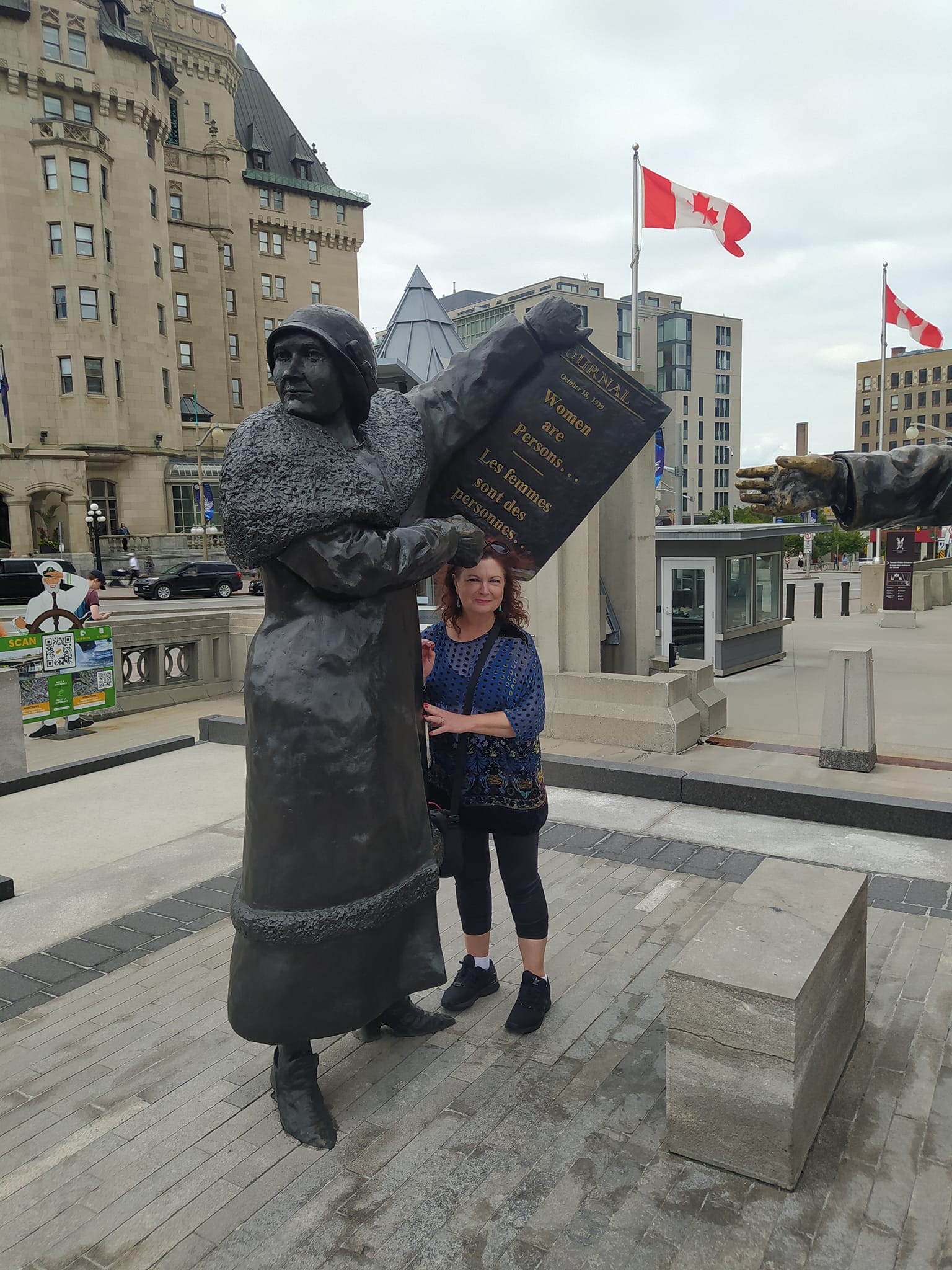
Suffragette City: Sharon and an earlier feminist in Ottawa

Wednesday was spent sightseeing. We were moved by the tomb of the unknown soldier; the tale of assassinated Irish founding father of Canadian democracy Darcy McGee; a visit to the Parliament Building on the Hill, and in particular by “Women are Persons”, a fabulous public art work by Barbara Paterson depicting the Famous Five suffragette women who won a significant battle for women’s franchise.  An evening meal and a few songs at Don and Paula’s rounded off a wonderful day.

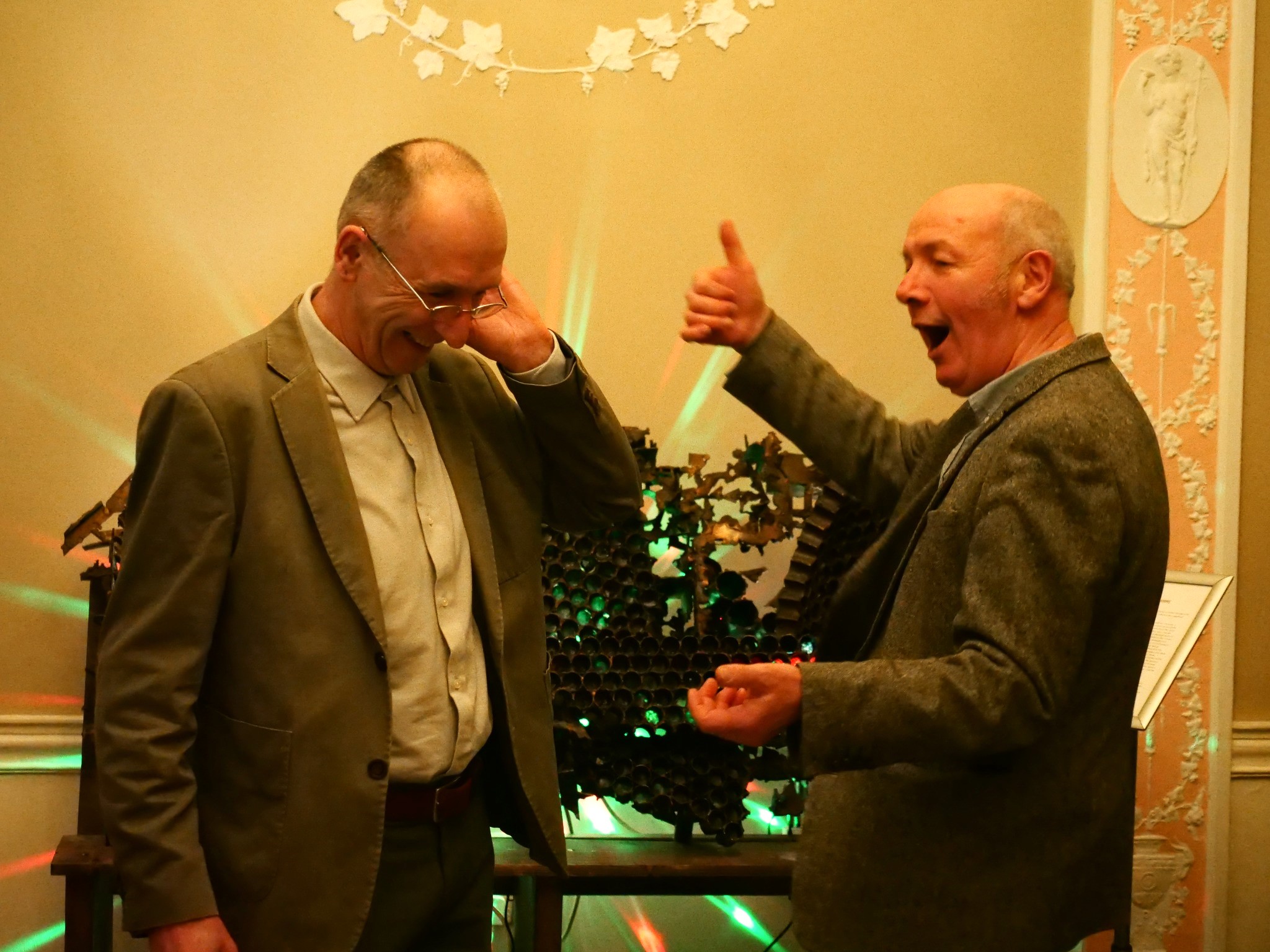
Thursday’s performance in the converted St Brigid’s Church – now repurposed as an arts centre – was a great success. Following a beautiful harp recital by the elegant Nora Pat Marshall, the evening was introduced in eloquent Irish and English by Rosemary O’Brien, Chairperson of the hardworking committee. The new work “Welcome O Joyce” (presented as a reading) was warmly received, its extracts from “Finnegans Wake” appreciated and its sideways segue into Molly Bloom’s dreams eliciting a fabulous, choral ‘Yes’ response from the lively crowd.  Part 2 of the evening saw my first Canada performance of “The Dubliners Dilemma”, reminding me that this mini-work, which tells of publisher Grant Richards’ difficult relationship with Joyce, has universal appeal. Joyce’s gleeful tales of the grimy underside of Dublin are as rich and tangible today as 110 years ago when the book first appeared (another anniversary!) They are a gift to the storytelling performer which is how I suppose I describe myself. The warm reception was crowned by the full house rising to sing me a Happy Birthday. There was cake and wine in the bar afterwards, but we took it easy as the following evening would see a livestreamed performance of “The Dubliners Dilemma” from the Annette Studio in Toronto. Among those attending the Ottawa show was former RTE producer John P. Kelly who lives now in Ottawa. John produced my only ever radio drama in 1987!

The Toronto event was hosted by the Alive Poets Society, of which my cousin Sean is an active member.

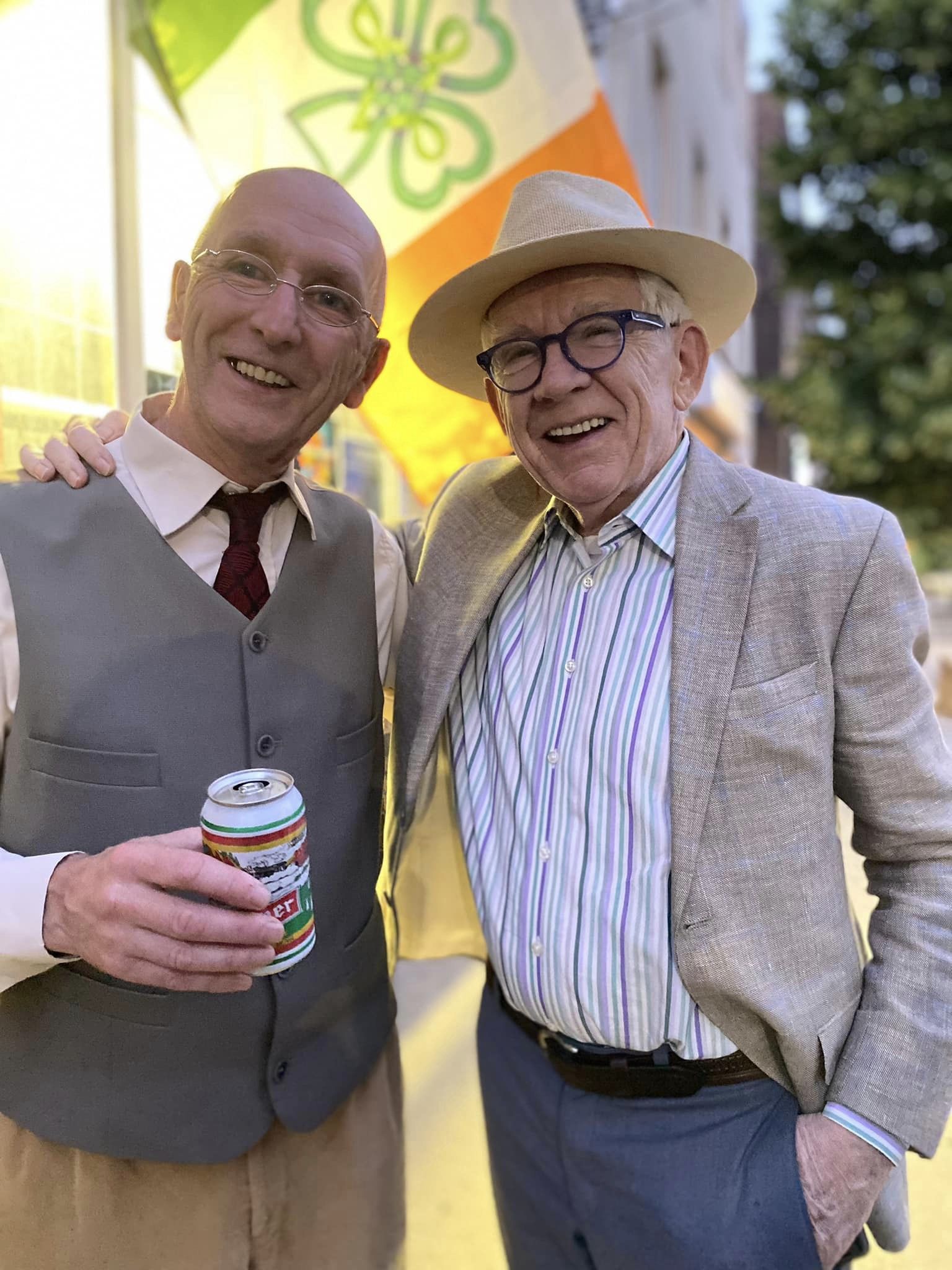
Post-show reunion with Paul Farrelly: At the Annette Studio, June 14th 2024

There was barely time after our six-hour train trip to dust down before a super-fast tech in the intimate and charming Westend jazz studio. Seanie, his wife Monique and poet accomplice Billy Heffernan had ensured that all the required stage furniture was in place, including a wonderfully elevated antique table on a wooden box for sightlines. I have seldom enjoyed a live show so much and the international audience was with the work all the way. A few contacts in Canada and USA who knew about it tuned in to the live stream, and messages of appreciation trickled in overnight. The evening continued with a perfectly curated selection of spoken word performances by the poets, and – once again – a song and a cake for what was my actual birth date, 14th June. The audience included Paul Farrelly a venerable stalwart of Irish and Joycean culture in Canada and – out of the blue – Dublin theatre director Alan Kinsella, an old pal and peer with whom Sharon and I had lost contact, now domiciled in Toronto.

With cousins Alice, Ann and Seanie Gorman: Corktown Pub Hamilton, Bloomsday 2024

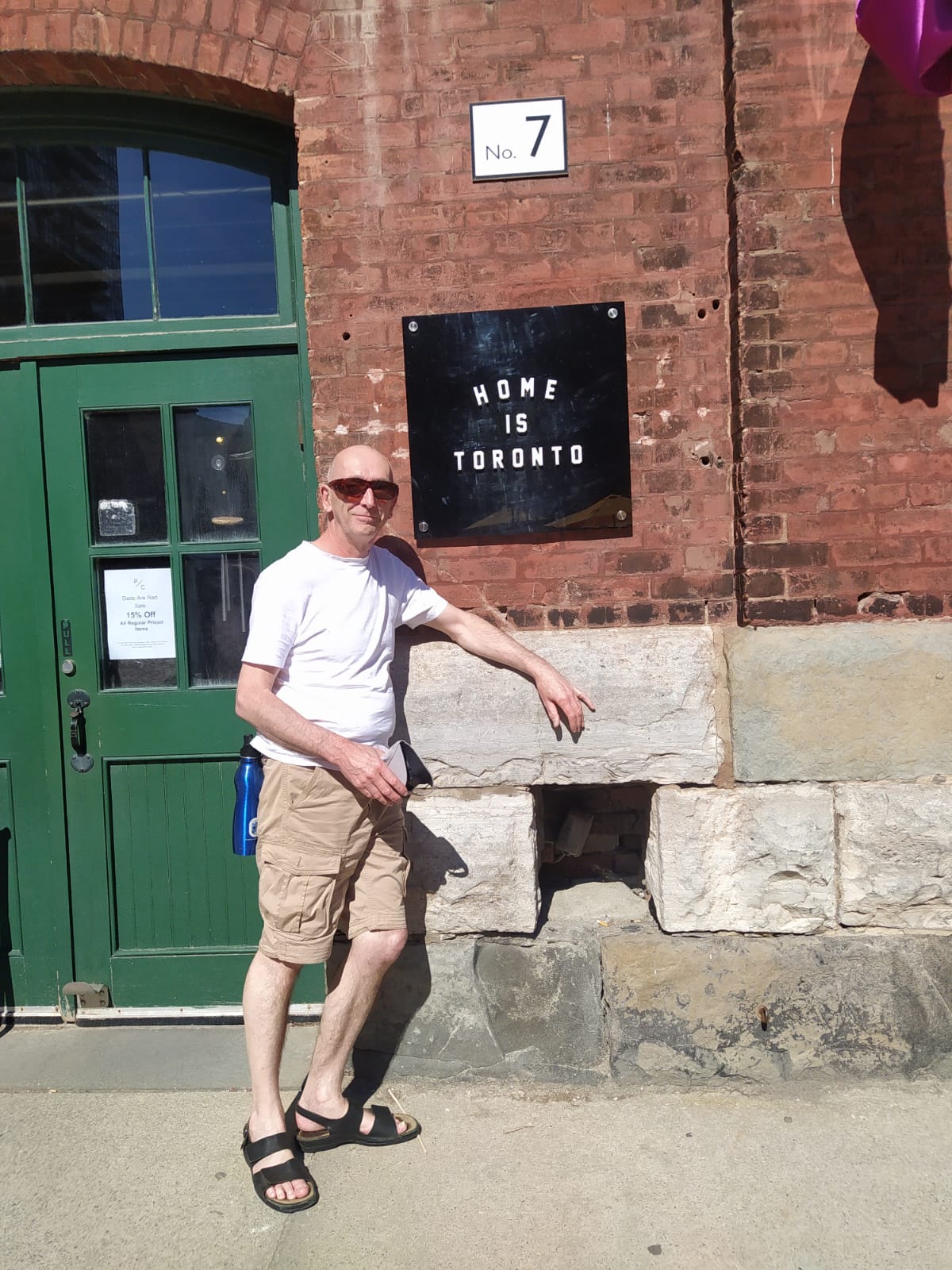
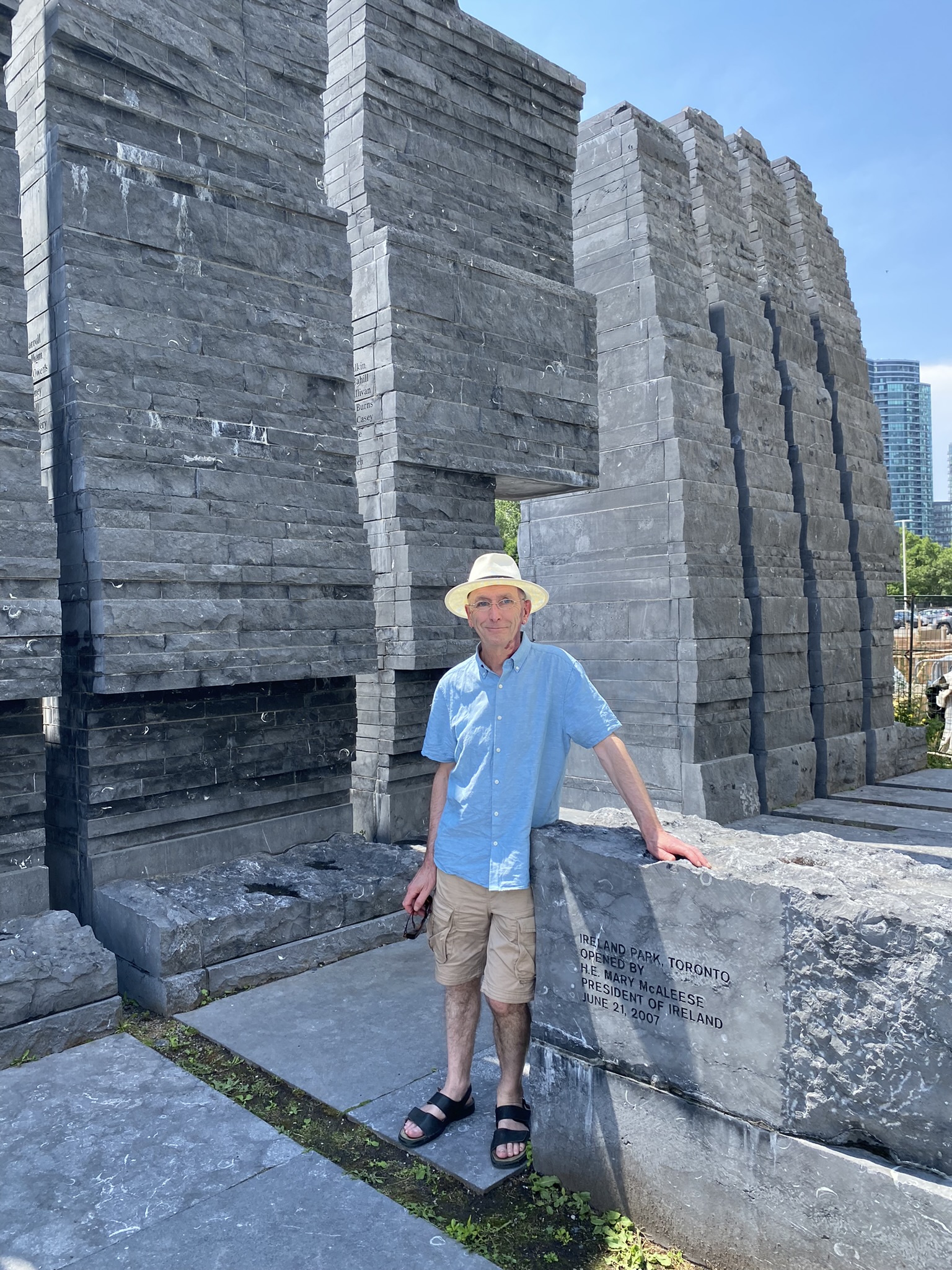
Saturday was another R&R day, spent mainly chilling in the revamped Distillery Quarter with live outdoor jazz, cool cafes and bars. Then, on Bloomsday, we moved on to the final show, a matinee in the unlikely but wonderfully hospitable Corktown Pub in the industrial steel town of Hamilton. Ann Gorman McKinney had done sterling PR work and they came from far and wide, many travelling over two hours to hear the words of James Joyce in this tucked-away haven of traditional Irish culture. I made a short thank you speech after the Hamilton performance, reiterating remarks I made in Toronto. My father’s brother Sean (deceased) had been very active in Toronto Irish circles. He was particularly supportive of music, so much so that after he died, the Toronto branch of Comhaltas Ceoltoirí Éireann was co-named the Gorman-Langan branch, honouring both Sean, for his organisational drive, and the great Chris Langan, a renowned maker and player of the uileann pipes. I was genuinely moved to thank the assembled musicians and singers for that honour. A suitably lively séisiún ensued, led by maestro John O’Gorman (no relation!) and crowned by Sharon’s wonderful Kimmage rendition of Molly Malone!

Our last full day was spent getting soaked and giddy on a tour boat under the magnificent Niagara Falls; followed by an all too brief visit to the pretty town of Niagara-on-the-Lake, home of the Shaw Festival, and a final meal with extended family on the hot evening terrace of a restaurant ovelooking Lake Ontario. After dinner I waded out and took a souvenir oval stone from the lake bed. I am looking at it fondly here on my desk now, a week and an ocean-crossing since, beside a few pebbles from my local Skerries beach, as I conclude this happy personal essay of a frantic but fabulous working vacation in the beautiful country of Canada.

Photos courtesy of Lensmen (Dublin); The James Joyce Centre (Dublin); The James Joyce Association of Ottawa; Don Cummer; Ann Gorman McKinney and Sharon Cromwell

Canada memories: People of all colours and creeds united in joy on the Niagara boat! Photo Ann Gorman McKinney

THE HALF COAT: CULTURE NIGHT IN CAVAN

What a fantastic night was had by all: actors, writer, crew, me (director) and audience at the world premiere of THE HALF COAT by Tara Maria Lovett in Cavan County Museum on Culture Night, Friday 22nd September 2023! As promised,the show programme is now available to view here! (Just below the photo) It is designed to download and print onto a double-sided A4 page. Try it and see!!! Further down in a lovely review in the Anglo Celt newspaper. It was an item in the first edition of the Celt in 1846 which inspired Tara Maria’s play about a condemned rebel in Cavan Gaol and the Quaker woman who visits him, and the ramifications of their actions down the generations.

Joshua McEneaney and Niamh McPhillips in The Half Coat by Tara Maria Lovett

PRISON NOTEBOOKS – PRESS RELEASE

PRESS RELEASE

DMAPP* in association with an Táin Arts Centre, Dundalk

presents

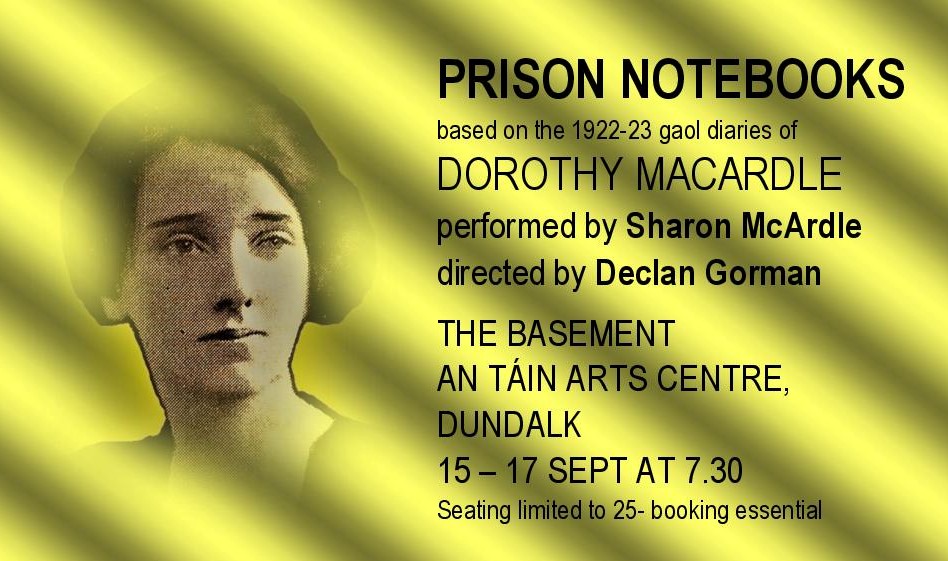
PRISON NOTEBOOKS

based on the Civil War gaol journals of DOROTHY MACARDLE

performed by Sharon McArdle

directed by Declan Gorman

choreographed by Ella Clarke 

with songs by Sophie Coyle

Basement Gallery, An Táin Arts Centre, Dundalk.

15th, 16th & 17th September 2022 at 7.30 pm

(and subsequent performances as mentioned below)

Dorothy Macardle was an outstanding Irish woman of the 20th century whose legacy and achievements are coming only now to wider public attention. She was a novelist, playwright, Hollywood screenwriter, historian and pioneering human rights campaigner.

Daughter of Sir Thomas Macardle, founder of the Macardle Moore brewing enterprise in Dundalk, she rejected her family’s imperial values and became – in her own words – “an unrepentant propagandist” on behalf of the Irish Republican cause. She was already an established Abbey playwright when she was imprisoned without trial for her Anti-Treaty propagandist activities in 1922. Upon her arrest, her literary manuscripts and private papers were maliciously burned on the street by Free State soldiers.

In later life, her original playscripts were part-damaged in the Abbey fire of 1961. Upon her death, her brother burned most of her remaining papers.  So much memory of Dorothy is thus obliterated even though in her lifetime she published a significant history and a number of Gothic novels one of which became a major Hollywood film, while also distinguishing herself as a broadcaster and laterally a human rights rapporteur.

In prison in 1922-23 she kept a series of six handwritten diaries, three of which survived and were found in the DeValera papers held by the Irish Jesuits and now in the UCD archive. Sharon McArdle has painstakingly transcribed these diaries (over 50,000 words), and it is hoped that this work will be published in due course. Unique in gaol journaling, Dorothy’s diaries include accounts of dreams, nightmares and uncanny future visions as well as moving testimony of deprivation, loneliness and hunger strikes among her fellow women detainees.

The prison diaries have now been adapted into a solo theatre performance by Sharon McArdle and writer/director Declan Gorman. They reveal Dorothy not just as a committed political thinker but a visionary artist, whose connection to the uncanny, and meditations on time, trauma and loss place her among the literary innovators of the early 20th century. Warm, humorous portraits of fellow women prisoners, tales of ghostly apparitions and devastating accounts of deprivation and violation blend with dreamscapes and paranormal episodes in this original performance which premieres at An Táin Arts Centre after almost five years of archive research and workshop exploration.

 The Dundalk shows will be presented in the intimate and confined basement workshop space (off the gallery) in An Táin. A private performance is also scheduled at Kilmainham Prison on Nov 22nd, for historians and scholars who have engaged with the artists’ research over the past five years. It is hoped to have two public showings at Smock Alley Theatre on November 15th and 16th.

Seating strictly limited. Booking essential.

Research and development of this work have been made possible with the support of the Arts Council (Theatre Projects Award); Create Louth – the Arts Service of Louth Local Authorities; Fingal Arts Office; Bank of Ireland Arts Awards and Dublin City University.  The artists wish to acknowledge the encouragement given in the early stages of their researches by the Dorothy Macardle Society of Dundalk as well as the constant support of An Táin Arts Centre.

DMAPP is acronym for the Dorothy Macardle Archive and Performance Project. Other upcoming work includes a Broadcasting Authority of Ireland and RTÉ funded radio documentary (with Lyric FM) to be broadcast on November 13th, and a short film in collaboration with An Táin film artist in residence Colm Mullen (release date to be announced).

Enquiries to DECLAN GORMAN – Contact details on http://www.declangorman.com

CENTENARIES AND ALL THAT JAZZ

I was nowhere near the place where Michael Collins was assassinated, this week. Honest!

I had thought once that I might be giving The Big Fellow a send-off of my own in this, the week of the centenary of his assassination. I had imagined myself perhaps, in a packed Broadway theatre … or at least back in the hall in Clonakilty where you might get a middling house and pay the actors a middling wage.

But fate and perhaps a little prescience guided us otherwise. Our little band, me, Cillian MacNamara (lighting), actors Gerard Adlum, Cillian Ó Garbhaí, and later Ian Toner (accompanied by Colin Blakey’s tunes), parted amicably and we each moved on to other projects and lives, having spent a couple of years (2016-19) touring from Bandon to Bangalore with our version of Frank O’Connor’s version of the life of Michael Collins.

In truth, it was O’Connor as much as Collins who drew me into this reflection on war, leadership and aftermath. I was fascinated that O’Connor, a gauche boy soldier on the Anti Treaty side should choose to write in adulthood a biography of his erstwhile enemy and find redemption in so doing. The epilogue to our play, beautifully delivered by Gerard Adlum, had O’Connor reflecting ruefully on his own grimy Civil War traumas and the impoverished infant State where he now served as a librarian. 

Collins appealed to me as a classic tragic hero who rises and then falls in the lonely valley to an epochal mix of his own flaws, the vengeance of enemies and the callous gods who planned his itinerary. O’Connor appealed to me as the artist who reflects on the futility of all this and finds in art, storytelling and myth his own truth.

I am now deeply immersed in and nearing completion of a collaborative work with performer/researcher Sharon McArdle on another Civil War figure, Dorothy Macardle, in whose book The Irish Republic – published around the same time as O’Connor’s biography – Collins is a mere irksome footnote. History is contested and constantly politically misused. More frighteningly, in this country and in Britain, it is misunderstood as Brexit and its legacy remind us.

The “Decade of Centenaries” was something of a contrivance by the Irish State to help us navigate the complexities of our nation’s difficult origin myths. Artists walk a tight rope, attracted by opportunities for funding but also for genuine research spaces, while wary of appropriation and assimilation into convenient commemorative narratives. I am uncomfortable with actual centenary events – be they of books by Joyce or the stray bullets of history – but I have gained much learning and creative understanding among outstanding artist colleagues, communities and academics this past ten years.

That is worth a quiet celebration today, at home, away from the centenary crowd.

————————————–

Michael Collins was killed in an ambush in County Cork 100 years ago on this day.

See archive images and text for our past productions and tours of THE BIG FELLOW here.

BOOKING LINKS FOR “FALLING THROUGH THE UNIVERSE” JANUARY 2022

FALLING THROUGH THE UNIVERSE

a staging of JAMES JOYCE’s “THE DEAD” framed in a personal memoir

Show information below the venue listings

—————————–

Dates and Tickets

Click on the relevant button to go to venue ticket sales

MILLBANK THEATRE, RUSH : WED 5th JANUARY at 6.30

SMOCK ALLEY, DUBLIN : 6th, 7th and 8th JANUARY at 6.30 (plus Sat Matinee at 3.00)

GARAGE THEATRE, MONAGHAN : FRI 14th JANUARY at 6.00 pm

AN TÁIN ARTS CENTRE, DUNDALK : SAT 22nd JANUARY at 6.00 pm

WEXFORD ARTS CENTRE : FRI 28th JANUARY at 8.00 pm

RIVERBANK, NEWBRIDGE : THURS 3rd FEB at 8.00 pm

Falling Through the Universe

Written and performed by DECLAN GORMAN

Directed by Gerard Lee

Lighting by Conleth White

On January 6th 1982, a young Irish emigrant borrows an English language book from a library in Munich.  He reads it over one evening. The course of his life is changed…. Forty years later, he walks onto a stage to recreate the magic of that night and perform one of the greatest short stories ever written in the English language.

Declan Gorman mixes memoir and the magic of live theatre to bring to life James Joyce’s much-loved January classic, “The Dead” in this warm and moving performance.

“A compelling performer”  Irish Theatre Magazine

The early development of this play and initial Work-in-Progress presentations (December 2018) were made possible with generous bursary support from Fingal County Council and The Arts Council.

WHAT HOPE FOR NORTHERN IRELAND?

Photo:Crispin Rodwell

My very occasional blogs are usually about my practice and observations as an artist. The link between this article and my work is tenuous in that it does not arise from a particular ongoing project. But it speaks to a theme as embedded in my psyche and my creative output as family and self: the balance between Hope and Despair in my native country – or more pin-pointed – in the disputed territory that is Northern Ireland

While Artistic Director of Upstate, (1996-2010), I spent many enriching years as a playwright, director and public artist engaging with communities, audiences and fellow-artists in Northern Ireland and in my home ground just south of the border. I would define that era as a time of peace building.

I continued this “engagement” work, but with less urgency, in a freelance capacity from 2011 to 2015, when peace appeared finally to have settled. Then, in 2016, Brexit hit us, confusing, incongruous and potentially lethal as any ticking bomb might have been, post-Omagh.

In 2018, when I was appointed Theatre Artist in Residence for County Monaghan, I made a few efforts to engage with this new reality through artistic work, but drew back from the enormity of it. While I have avoided it in my work, through all this time, I have journaled obsessively – but never published – my turbulant thoughts on the implicatons of Brexit.

This year, Northern Ireland is 100 years old. In recent days, controversy has gathered around President Michael D Higgins’ decision not to attend a church service which set out to mark the partitioning of Ireland in 1921. Some commentators have stated that his decision was retrogressive. Did we not, after all, relinquish our claim to Northern Ireland when we voted to remove Articles 2 and 3 from the Irish Constitution in 1998? Can we not move on and let bygones be bygones? That particular remark has caused me to return to a journal entry I wrote some weeks ago, before the Higgins controversy erupted, and finally publish my personal views.

I hope this essay (1400 words) might find a few readers and stimulate some honest reflection on the irreparable damage Brexit has done and the subtle way it has changed (utterly!) the context of all talk of peace and reconciliation.

Above all, I hope that the finest and most imaginative minds on this island and beyond might begin to think up new pathways out of the brewing disaster we are living in but failing to name. Certainly tinkering with a trading protocol and providing reactionary forces with phantom causes will do no more than postpone a looming tragedy …

WHAT HOPE FOR NORTHERN IRELAND?

A reflection

One of the reasons so many people in Ireland were, and remain, appalled by the Brexit Referendum is that no political event in our lifetime better illustrates the failure of a people (the people of Britain) to understand or learn lessons from their own history.

In 1998 voters in both parts of the partitioned island of Ireland collectively set aside centuries of enmity and polled in favour of the Good Friday Agreement. 

By an even greater majority, the people of the Republic voted to repeal Articles 2 and 3 of a constitution that had staked claim to disputed northern territory which had remained in Britain’s keep for almost 80 years after their occupation of the southern regions of Ireland ended.

While this momentous 1998 peace accord is usually analysed in terms of its impact within Ireland, it is helpful to reflect on the gift that the Good Friday Agreement was to the people of Britain. 

After centuries of sporadic warring between the two nations, and bitter strife locally between British colonisers and their descendants on one hand and indigenous Irish people on the other, Irish voters agreed, en-masse and for the sake of peace, to allow Britain retain dominion in Northern Ireland.  The Good Friday Agreement also allowed one million ethnic Britons with by-now deep roots in Irish soil to live and look ahead without further fear of armed rebellion. 

The key condition was that Irish identity would be recognised as wholly equal in what would remain a British territory but be reinvented as a shared society.

Underpinning or – perhaps more accurately – overarching this concept of a shared society was the relatively new 20th century context of a peaceful and largely borders-free Europe, where Britain and Ireland co-existed as equal members of the European Union. It was a sensible modern-day compromise and an apparent conclusion to a centuries-old history of colonisation and land theft too embedded by now to be reversed, but until modern times ever-raw and ever-oppressive.

And then, no sooner was accommodation reached but, within 18 short years, this generation of British political leaders, and so many of their unthinking followers in England in particular, threw the gift of the Good Friday Agreement back in the faces not only of Irish people and their European allies, but of their own fellow British-identifying people in Northern Ireland.  

In extracting themselves permanently from the European Union, Britain removed overnight the only context within which ethnic and national identities on these islands might evolve outside of the historically exclusive tenets of territorial ownership.  In simple language, the Brits took back the North.  The people of England reclaimed Northern Ireland as exclusively British, and no longer shared-European.  Ignorant British voters may not have known – but their leaders most certainly did – that it has never been, and never will be, possible to live at ease in an exclusively British part of Ireland and identify freely and equally as Irish. 

The reality, therefore, is that the Good Friday Agreement is to all intents and purposes dead in the water.  Irish and European negotiators are currently struggling to protect some of the economic and bureaucratic structures enshrined in the accord which are now in disarray.  But nobody appears to be acknowledging that the Agreement itself has no basis anymore. That ship has sailed and with it the only apparent hope of a mutually acceptable accommodation.

If the people of a disputed territory can no longer be “British, Irish or both” as the generous dispensation of shared EU membership allowed, then it follows that Northern Ireland and her people officially can only be one or the other: British or Irish. 

Northern Ireland is currently exclusively British once again. You can hold an Irish passport and enjoy rights just as Indian or Dutch people in Belfast may hold Indian or Dutch passports and be entitled to certain rights.  But you have no ownership.  You cannot be loyal to the only recognised governing polity.  You are once again a foreigner in your own land. 

While there have been disturbances and the young journalist Lyra McKee had her life taken away in one such catastrophic incident, by and large nobody has taken to armed warfare about this just yet.  Sinn Féin, however, are pushing for a poll that would – they anticipate – swing things so that Northern Ireland would secede from the United Kingdom and be “re-united” into a new all-island Irish Republic.  If that happened, then Northern Ireland would become exclusively Irish.  Republican advocates of this strategy tell us with blithe confidence they are certain one million ethic Britons will accept this four-hundred year reversal and welcome the economic benefits of a future United Ireland. 

As if economics has ever had anything to do with identity in Ireland.

While some romantic ideal of a United Ireland may appeal to the naïve among us as well as to more belligerent Republicans, anyone who has ever studied Northern Irish history will know that it can never come about without bloodshed, counter revolution and a different kind of counter repression.  Consider Unionist and Loyalist reaction to every perceived threat, however minor, to the Union with Great Britain, from Home Rule to the Civil Rights movement to Sunningdale to the lowering of Union flags over certain public buildings. Every such move has been greeted with mob mobilisation and violence up to the level of murderous pogroms and random assasinations of nationalist Catholics.

Perhaps the reason so few people are facing the reality that the shared identity solution is now off the table is that eternal warfare seems the only corollary, and it is simply too terrible to contemplate.  So, politicians tinker around the edges, seeking to salvage or undermine this Protocol or that Annex designed to preserve institutions and trade corridors that were viable only in the brief time of our shared EU history.

It is almost impossible to see how the safeguard of European Union membership can be replaced in the future with any framework that could allow Northern Ireland to be neither one thing predominantly nor the other. 

The only possible hope may lie not in an overarching, protective super-national community but through radical new investment in the concept of community at the most local level. 

Unless and until the peace-preferring people of Northern Ireland can turn respectively to London, Dublin, Brussels and their own enslaving dominant politicians and say, “Step away for a while and leave us to talk and figure out a way of our own”, the hovering menace of renewed division and suppressed violence will fester until it once again explodes, as it has done cyclically over the past 100 years and for centuries before that.

In short, extreme devolution in tandem with meaningful cross community local dialogue and empowerment may be the last and only hope. But right now, the only people with the means to do this, the power-greedy politicians leading the dominant parties within Northern Ireland, are offering no hope.  No real talking, no honest acknowledgment of the true problem – just position-taking and subtle, incremental incitement to violence.

There is some light – it peeps in, in little chinks.  While violence has simmered, it has not yet ignited.  There is much talk of new identities – gender, intercultural, ability and so on.  Young people in a global world, we are told, are ahead of and bored with all that old national identity politics. 

But we thought that to be the case too in the heady, progressive 1960s when Protestant and Catholic marched together for Civil Rights, and look what happened.  One bomb, one sectarian assassination, one deadly riot, one Twelfth march that turns violent, one street of houses set alight.  That is what it takes to drive the well-meaning in a society without safe structures back behind barricades as the old warmongers reclaim the streets.  Without structural support and great acts of letting go by current power-holders, young people with all their new ideas and identities will not make it alone.  Enmity, hatred and hurt have long memories.

It is pitiful, five years after Brexit, to see politicians still playing games that stir up divisive sentiment.  It took just 18 years for Britain, true to form, to unravel the only apparent basis for peace in Ireland.  It may take 18 years and more for Ireland to experience the worst consequences.  But if things continue as they are, with bad faith now a badge of honour in Downing Street, misguided band-aid approaches from Europe and incendiary cynicism the main currency in local Ulster politics, those consequences will eventually play out.

It would suit all concerned better to prevent this: to speak honestly to the insecurities and ancient fears of the “other” in this still bi-polar society rather than play to their own gallery just now.  Ah but that takes local leadership!  And where, oh where, will that come from?

ONLINE THEATRE! WHAT EVEN IS THAT?

It is quite something that an amateur drama group in a small town in County Cavan, Ireland, have recently created The Pilgrims of Slieve, one of the very, very few full-length Zoom Dramas ever made in the long history of the world! 

So – apart from the obvious ….. switch on the laptop and click on the link …. how exactly should the viewer watch such an event?  Well, the general advice for watching any online theatre event applied to this collaborative community production which I was privileged to direct for Aisteoirí Muinchille (Cootehill Payers) in March 2021.

My friend Paul Hayes, Director of An Táin Arts Centre in Dundalk, says that when he and his actor wife Leah Rossiter sit down to watch theatre online, they make certain preparations.  “We might rearrange the furniture; dim the lighting to create a more theatre-type environment; have drinks prepared in advance.  Above all, we switch off mobile phones, just as we would in a real theatre.”
And that is the key: “Just like in a real theatre!”  You would not bring a barking dog with you to the Abbey.  Is there somewhere the dog could go for 90 minutes while you watch your play online at home?

But then, why should you go to these lengths to watch a play when you often sit comfortably through a feature film on Netflix without any such fuss?  That is what this article sets out to explore.

—————————————–

As someone who not only works in theatre, but loves attending plays, I can say two things with absolute conviction.

  • Firstly, in any situation and in any normal time, going to the theatre is different to taking in a movie or going to a concert.
  • Secondly, there is really no such thing as “online theatre”!  Like theatre itself, the whole thing is a pretence, and it require the audience to take part in the pretence. 

When I assert that theatre is different to taking in a film, I’m not saying it’s any better than cinema or live gigs, (although personally I prefer theatre).  But in obvious ways, it is different. 

You arrive in good time; you do not eat popcorn; there are no ads or trailers; you sit among your neighbours or complete strangers pre-curtain and sense the unique communal anticipation; you absolutely turn off your mobile phone!  In short, even for a light, local comedy, you prepare to zone in and concentrate.  When the first actor finally takes the stage you lean forward to listen.  If (as is usually the case) the actor is talented and trained, you embark with her or him upon a journey that takes place partly in front of you but partly in your own imagination. 

Great theatre leaves a lot to the imagination – largely because, unlike film, it cannot show you everything. We rely on the power of the text and the physicality of the actors mainly to create the sense of place, time and context.

What is the online equivalent of that unique contract of the imagination?  Well, quite simply, there is NO equivalent on your laptop!  It does not exist.  The audience is at home, not in a darkened auditorium.  The dog is barking; there are people coming and going…. the actors are not at all impressive in their physicality, existing only on a small, very flat, two-dimensional screen.  …. Unless…

Unless a different “contract” is negotiated, suited to the time and circumstances of this odd period in world history. 

—————————————–

When Aisteoirí Muinchille contacted me last November and asked if I might lead some kind of drama process with them online during the pandemic, I agreed, but on condition that they would travel with me on a mutual learning journey.  With extraordinary courage and enthusiasm they said, “Yes!”.  Every Monday night Zoom workshop after that was an experiment (16 weeks in total!).  Not only would the usual values of community-engaged devising apply: inclusiveness; good humour; gender equality and so on – but we would dedicate time to road-testing totally new ideas.  How could we create a new play that might engage the audience’s imagination on little computers?

You cannot have choreography in the normal sense of the actor’s physical presence, but what is the effect of ten heads all turning simultaneously to look up at an aeroplane?  What is the effect of having eleven actors in black tops speak verse against a virtual black background?  When is enough and when is too much of poetic speaking or of black t-shirts against black backdrops? And so on.

In the 16 weeks of rehearsals, 20 hours of filming and one intensive week of editing to whittle it all down to a 90 minute drama, it was my instinct as a theatre director – not a film-maker; not a film-editor – that guided my choices.  We were very clear that we had made a piece of theatre!  Although I have only ever met one of the actors face to face; although the play was performed by the actors sitting at their laptops in their 12 separate, isolated home locations, we had created a community play not a Zoom conference.  It looks like theatre; it almost smells like theatre….

But to complete the arc of the journey, we needed the audience to agree to take part with us in a final imaginative process.  We needed them to pretend they were at a theatre of some kind!

—————————————–

Theatre is often described as “the willing suspension of disbelief”. Like children playing in the garden, the audience undertakes to believe the deception of theatre: the man in the wire mask is a great horse; the Greek woman describing a massacre is actually seeing it, and so on.  The design of the auditorium facilitates this: the curtain rises; the house lights go down; the stage lights come up.  Silence falls.  The actor moves or speaks.  We move with her.

But now, in a new, emergency situation for theatre, we ask that the “online theatre” audience undertakes this “suspension of disbelief without the aid of the dimming lights, the community in the room, the physical presence of the actors. 

In short, we ask that the audience comes at the work prepared

At home we do not often prepare.  We flop down in front of the telly; we grab lunch as we move around the house; we flick through Whatsapp messages almost unconsciously.  But we do prepare for some things!  We prepare to go out for a special occasion, with make up and perfumes or a clean shave and a fresh shirt.  We prepare for the arrival of visitors by digging out the good crystal, laying the table, cleaning up the place a bit.

So, for this “online theatre event” we unashamedly ask the audience to prepare! 

While they might well enjoy “The Pilgrims of Slieve” on a mobile phone as they shuffled around tidying the kitchen, it was unlikely!  Having paid good money to have us in their homes., we wanted them to get full value from us: to think of us as visitors, arriving, bearing gifts. 

Get your house and your head ready, we said!  Prepare to relax!  Prepare to travel with us on a journey of the imagination.

Precisely what might this involve? A list of simple, practical tips to achieve it was published on a resource page accompanying the show.  It applies to most online theatre experiences.  You can read it below:

THE PILGRIMS OF SLIEVE

TOP TIPS FOR VIEWING:

Watching a 90-minute online play is very different to just flopping down to watch a TV show.

Here are 10 top tips to make the most of your Ten Euro Ticket.

We recommend that you:

“HOLD THE PLAY, HOLD THE PLAY, I’M JUST OUTSIDE THE THEATRE!!!”

1. “Arrive on time and ready”:  Don’t find yourself running around after the play starts, looking for speaker cables or whatever.  Once you sit down, sit down!

2. Watch on a laptop rather than a phone.  (You can also watch on a Smart TV, but the medium scale of the laptop gives the best picture).

3. Arrange the viewing room so you can sit comfortably in front of the laptop.

4. Dim the lighting in the viewing room, even if you don’t normally do this for TV.  This is theatre, not television.

5. Use external speakers, if you have them!  Sound is important.  The better the speakers, the better the experience.

6. TURN OFF ALL MOBILE PHONES!!!!!

7. You might like to pour yourself a drink: maybe even indulge in a box of chocolates!  But have it all ready in advance.  Don’t be getting up mid-way through to go to the fridge or the loo.

8. Think of anything else that might disturb your viewing, and do your best to deal with it beforehand: the barking dog; the roasting dinner; the children’s bedtime.  We know that every home has its own circumstances and some interruptions are inevitable. YOU know what is best in your “home theatre”!

9. You are invited to download the show programme and read about the actors and even have to hand a running order of scenes (Click to access the-pilgrims-of-slieve-programme-2.pdf)

10. ONE FINAL INSIDER TIP! You can (and preferably should) watch the full 90 minute drama in one sitting.  But if you really need to step away, you can of course pause it after 35 minutes (End of Act 1) or 70 minutes (End of Act 2)!