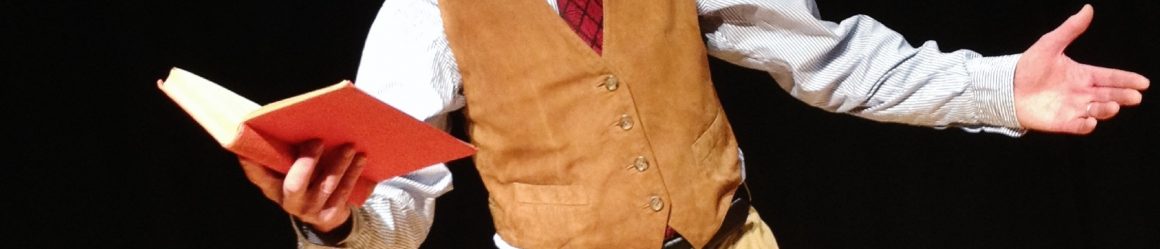
I am six months behind, bringing this piece up now! In November 2025 I had the remarkable honour of delivering rhe annual Patrick Kavanagh Lecture at the Kavanagh Weekend in Inniskeen. Due to a computer crash and lack of general ability to simply get my act together in the real world, I no longer have my original paper to hand. I am grateful to Veronica Corr of the Northern Standard Newspaper (since sadly closed down) who sent me a copy of her in-depth report on the festive weekend, including this abridged but largely verbatim summary of my presentation.
I dedicated the paper to the many poets and artists present at the event – as the paper deals partly with the artist’s struggle. I recalled in particular the work of the late broadcaster and actor Seán Rocks – like myself a Monaghan native. The abridged pages below include anecdotes of my time working with Seán in the early 1990s, a matter further parsed in a wonderful post-lecture interview on the stage with journalist Frank McNally – yet another creative man of Monaghan. (the interview transcript is not included here.) I hope you enjoy this “second hand” recall of my life and times in the gigantic shadow of the original Monaghan writer and genius Patrick Kavanagh.
Theatre Practitioner Declan Gorman Delivers Keynote at Kavanagh Weekend Launch
By Veronica Corr
The Kavanagh Weekend is one annual event which always marks the passage of time for this reporter, and Friday night last was spent soaking up some culture. Declan Gorman was the keynote speaker at the launch event. His autobiographical paper was heartfelt and humorous. He dedicated it to all artists in attendance at the Kavanagh Weekend.
Darren McCreesh, Manager of the Patrick Kavanagh Centre and Director of the weekend of events, was delighted that Declan agreed to deliver the keynote. Declan, Darren said, was not only one of Ireland’s great theatre practitioners and arts activists, but he was also from Monaghan Town. Darren recalled that Declan adapted The Green Fool for the 2004 centenary of Kavanagh’s birth, and Declan went on to tell a hilarious story about how the play came about!
He began by saying he was delighted to be back in Monaghan county, especially the part of it that straddles Louth, as his mother was from Hackballscross. He recalled a time not long ago, struggling through the recession, wondering if art was powerful enough to sustain him, noting that when he met Darren a decade ago, and Darren invited him to Monaghan to do a residency, it was a turning point.
The keynote speaker went on to pay tribute to the late great Sean Rocks, for whom the arts community is in mourning.
“It’s been very much on my mind preparing for this evening, that we lost a great Monaghan man very recently. A giant of the arts who died too young and too suddenly. Sean Rocks was my colleague and friend for many years. I knew his family growing up in Monaghan Town. I toured with him in 1993 when he created perhaps the most memorable theatrical performance that I had ever witnessed, that of Francie Brady, the butcher boy in later life, looking back in Pat McCabe’s resonant drama, Frank Pig Says Hello … I had the grand title of producer. My main job was to write the paltry wage checks every week for the actors, and also to ensure that the actors and Pat got out of bed in one town early enough to travel by the hired car to the next!”
Noting that the distances weren’t huge to begin with, the play went on to tour internationally, but Declan bowed out in the UK: “That original production of Frank Pig Says Hello went on from Dundalk to London, and from London to Australia and America. But I was like the lad that left The Beatles just before they got famous! I left at London. Amicably, it has to be said, before the show went further abroad.”
“I miss Sean dearly, even though I had less direct dealings with him in recent years. I miss him in my car as I drive along that same zig-zag route in Cavan and Monaghan about my business as a rural community artist. I miss Sean on the radio, bringing culture to the people. His lovely Monaghan cadence echoing down the airwaves in every home, car, and van in Ireland, reminding us that art is mainly good fun, joyful and accessible. There for all of us if we care to look and listen, even when it is earnest, puzzling, or provocative. He did that very well. May he go gently on.”
“That was 1993: I was already two or three years into a job as a curator and programmer at a community arts centre in the rundown Docklands of Dublin. I had previously worked as a producer and actor in the independent theatre, as we called it, The Fringe. I had set up a company, Co-Motion, in 1985, along with Joe O’Byrne, and we made a few memorable waves in and around Temple Bar before it was Temple Bar. Our work was overtly political, raging against apartheid, urban poverty, and other social ills of the day. I cared very deeply about these things, about politics, about the marginalised in society, but I sensed increasingly on The Fringe that we were talking among ourselves, preaching to a tiny, converted handful of left-wing graduates and activists in the bohemian back streets.
“But all of that changed when I moved to City Arts Centre. I spent a lot of time out and about in the inner city and the bleak suburbs, meeting with community activists who were using drama, dance, and visual art, as we used to say, to give voice to the marginalised. in a city that was just acknowledging the true ravages of a decade of mass unemployment, emigration, and drug damage. I found this alternative emphasis intriguing,” Declan observed, before continuing:
“What might be the impact of artists engaging directly with submerged and broken communities and enabling spaces wherein the people’s own voices might be heard? … I sat in a darkened pool hall in Clondalkin and watched young women from a lone parents’ support group rehearse sketches and songs of struggle that they had written themselves with guidance from a drama worker called Joni Crone and I quietly wept in the dark, suffused with heartbreak and joy.
“I befriended a young Castleblayney woman, Kathy McArdle, daughter of Tommy of this barony and she invited me out to Rialto in Dublin 8, where she was working with older teenagers from Fatima Mansions and Dolphin’s Barn, alongside writers John Bissett and Grainne Lord, to create a true-to-life fictional drama about a young couple dying of AIDS. I learned that the 11-acre flats area known as Fatima Mansions had the highest concentration then of heroin-related AIDS mortality on the entire continent of Europe. In due course, we hosted that drama by the Rialto Youth Project in the little 60-seater space at the City Arts Centre … and as the play unfolded, I wept in the dark again,” Declan revealed.
He debated whether the critics might consider it art, but he didn’t care. It was great because it was true. He wondered if slicker productions could claim to be as authentic, but conceded “upon mature reflection, I acknowledged that nobody has the monopoly on creativity, just the same way nobody has a monopoly on truth.”
In paying tribute to his fellow artists, he said: “Most artists strive for truth. That’s why so many of them over history have existed on the margins and suffered for their difference. I couldn’t help but love the theatre, even in its more bourgeois settings. Try as I would to be a hard-left radical, I knew within me that just as I had a foot in more than one county, I had a foot in more than one culture club.
“I was and still remain, a passionate advocate for community and participatory art. I believed in its potential for radical social upheaval. But equally, a high-brow show … could also move me to tears in the dark. Tears of sorrow, Tears of joy, and take me to places beyond the earthly streets of inner Dublin. Art, and theatre in particular, are transformative.”
Aged 38, after a decade of observing from the sidelines, Declan decided to give up curation and adopt again the mantle of artist. Artists, it seems, like the rest of us, appear to suffer from imposter syndrome. They think of other people as artists, rather than themselves. Declan described himself as a “socially conscious interloper with a broad Monaghan accent.” He discovered that he had something in common with Kavanagh.
“The artists conundrum, how do you write your truth in a close-knit community, and yet retain and develop your audience? And astonishingly, it took me until 2004, by which time I was 45 to realise that one man more than any other seemed historically to have embodied and expressed intuitively a great many of the contradictions that I had been trying for 20 years to resolve and navigate.”
Declan went on to share the hilarious tale about the time he talked himself into a job: “I attended a launch event in the year 2003 in this very building and a lady known to you all, Rosaleen Kearney, came up and she said to me, ‘Your theatre company might think of doing something for the Kavanagh Centenary.’
“The then Minister for the Arts, John O’Donoghue, was present, and there were hints that some Government money might be floating about. So, without as much as blinking, I told an outright lie. I looked the Minister in the eye, and I said, ‘As it happens, I’m working on a stage adaptation of The Green Fool, so I am!’
“There was no turning back. I went home that night and took my 30-year-old copy off the shelf, and I re-read it in one sitting. And two things occurred to me. One was that it was very enjoyable, laced with precisely the rustic humour I had enjoyed so much from working on the Macra plays. A fast witticism on every page, a pure joy like a comic book.
“The other was that no matter what way I looked at it, there wasn’t a play in it! The Green Fool is a series of rambling anecdotes. It has no tension no conflict, no dramatic arc. There might, at best, be a night of comic sketches and capers for the local parish hall in it.
“That’s how I felt, and I couldn’t sleep with the horror of it! In front of a Government Minister, in front of Rosaleen, the kindly and scholarly manager of the Kavanagh Centre, in front of the assembled poets of Ireland, I had committed to something I could not do and that could not be done! “The Green Fool had never been done and now I understood why!” he said, as the audience laughed with him.
Declan mulled it over for a while and recalled that he read about Kavanagh rejecting The Green Fool in later life. “Why would a twinkle-eyed rogue reject his own early effort and it to be so entertaining and accessible? I ran out the next day and bought Antoinette Quinn’s magnificent biography, and I read it in a week.
“It was a question of truth. The artist rejecting himself or the untruthful part of himself as he rather harshly judged the situation. There was something in that: judgement. The courtroom drama, the most enduring of theatrical genres, the case of Kavanagh versus Kavanagh, and bingo, I had it!
“I placed Kavanagh at 50, played brilliantly by Padraic McIntyre, opposite young Patrick, played by rising Monaghan star Nick Lee, into a philosophical combat interspersed with hilarious physical scenes from the book … peppered with Kavanagh’s most quotable quotes and a few of his finest lines of verse, concluding with a nightmare trial scene derived from Patrick’s own legal downfall at the hands of Oliver St. John Gogarty.”
Declan said that The Green Fool was the most successful thing he ever composed, having its world premiere in the Patrick Kavanagh Centre, as it was before the refurbishment. It went on to tour all over the country and headlined the Belfast Festival at Queens.
Reflecting on the experience, Declan confessed: “It also brought me very close to Kavanagh. I spent a lot of time in his company that year, and it was a strange kind of reconnection for me, like a grudging fondness you might develop in midlife for an eccentric uncle you had half loved but half rejected in adolescence.”
He also recalled a letter written to The Irish Times by Alice Leahy on the occasion of Kavanagh’s Centenary thanking him for inspiring her to do charitable work with homeless people, Declan commented: “Kavanagh was a true outsider, she wrote, citing his lack of formal education, his difficult personality, his loneliness in times of extreme poverty in his flat on Waterloo Road, and the solace he found in alcohol and the pain it brought. The enduring power of Kavanagh, she concluded, is his ability to make us feel uncomfortable about a culture which places an almost disturbing emphasis on conformism, with scant, if any, regard for those who do not or cannot fit in.”
 Declan Gorman